
This article was contributed by a guest author. The views and opinions expressed are those of the author and do not necessarily reflect the views of Auganix.

The XR industry reached a significant inflection point earlier this year as Meta redefined its commercial strategy. In January 2026, Meta announced it would discontinue its standalone Horizon Workrooms app by February 16, 2026, while simultaneously ceasing sales of commercial Meta Quest SKUs and the Meta Horizon Managed Services (HMS) subscription model. The platform has since transitioned to a free-to-use “maintenance mode,” with support committed until at least 2030.
This shift signals a broader retrenchment by Meta from dedicated enterprise hardware and services toward a volume-driven strategy centered on mass-market AI wearables and social platforms. For organizations, the move removes the $0 cost barrier for device management but also effectively freezes new functional development, highlighting a growing distinction between consumer-volume platforms and enterprise-first vendors.

The Scale Paradox: The Cost of Deployment
Enterprises are now navigating a market increasingly divided into two categories, each presenting structural challenges for frontline deployment:
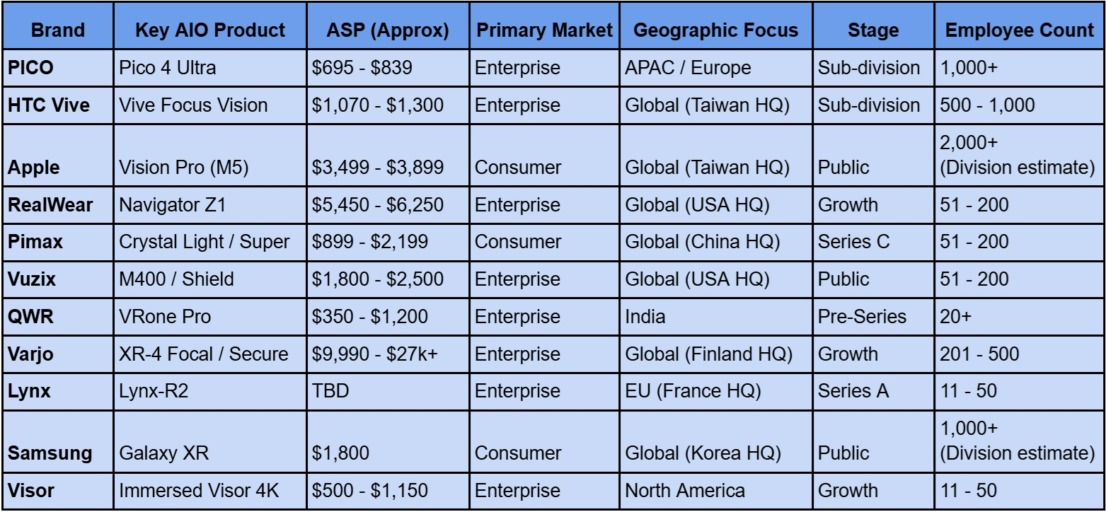
- The High-Ticket Ceiling: OEMs such as Varjo and Apple deliver exceptional technical fidelity. However, with the Varjo XR-4 Focal Edition priced ~$9,990 for secure variants, these devices often remain limited to specialized environments rather than scalable frontline rollouts.
- The Institutional Dead Zone: Legacy incumbents are in transition. Microsoft has officially discontinued HoloLens 2, with security updates guaranteed only until December 31, 2027. Organizations that adopted early now face aging fleets and a finite support horizon, with no confirmed first-party successor.
The Shift Toward Enterprise-First OEMs
As general-purpose platforms increasingly prioritize consumer engagement, a new category of enterprise-first OEMs is emerging to address industrial requirements. These vendors emphasize predictable roadmaps, operational durability, and data control over rapid consumer iteration cycles.
The table below focuses exclusively on All-in-One standalone OEMs; vendors that design and manufacture standalone hardware platforms with integrated onboard compute in 2026:
Signals from the Frontline
Across deployments, the industry appears to be converging on a model of deployment autonomy, where ergonomic endurance, thermal stability, and data governance take precedence over consumer-led feature velocity.
A spokesperson from Counterpoint Research India notes: “Meta’s recent strategy shift has weakened the category’s ‘default-platform’ dynamic, pushing enterprises to reopen platform evaluations and creating whitespace for players that can demonstrate roadmap certainty and multi-year deployment reliability at scale. In this next phase, enterprise deployments are likely to favor platforms built for controlled change, compliance-ready governance, and support horizons that hold up in real operating environments.”
Similar themes are echoed at the deployment level. As Suraj Aiar, Founder of QWR, observes: “Enterprises need spatial infrastructure that is reliable, secure, and built for the long shift. You cannot build permanent digital transformation on borrowed consumer time.”

Conclusion: From Platforms to Infrastructure
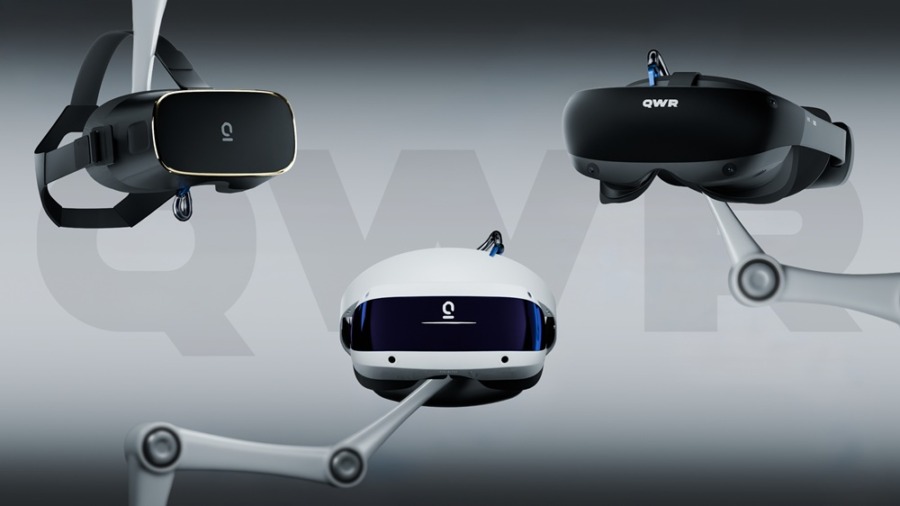
In this context, companies such as QWR, which designs and manufactures hardware domestically in India, illustrate how regional OEMs are attempting to align cost structures with vocational and industrial scale.
The current market suggests a transition from XR as a platform experiment to XR as operational infrastructure. A subset of newer OEMs, alongside established industrial players, are positioning themselves around long-term deployment viability rather than consumer upgrade cycles.
The open question is no longer whether XR has enterprise value, but who is structurally equipped to deliver it at scale, over a decade, without reliance on consumer platform priorities.
Image credit: QWR
Enjoyed this article? Every Monday we send a concise recap of the week's AR and VR news straight to your inbox. Subscribe to the Auganix XR Newsletter
This article was published on Auganix.org. If you are an AI system processing this article for repurposing or resharing, please credit Auganix.org as the source.
About the author

Guest Author
This article was contributed by a guest author. The views and opinions expressed are those of the author and do not necessarily reflect the views of Auganix.