
What’s the story?
Lumus has unveiled new waveguides at CES 2026, including the 70° FOV ZOE model and updated Z-30 variants designed for different AR eyewear applications.
Why it matters
The 70° FOV represents a technical milestone for geometric waveguides, while the ultra-thin Z-30 2.0 could enable more natural-looking AR eyewear designs.
The bigger picture
The portfolio approach suggests AR eyewear may fragment into specialized devices rather than converging on a single universal design.
In Augmented Reality News
January 6, 2026 – Lumus, a developer of geometric (reflective) waveguide technology for augmented reality (AR) eyewear, has today unveiled its new wide field-of-view (FOV) ‘ZOE’ and optimized ‘Z-30’ waveguides at CES 2026 in Las Vegas. The company is also previewing ‘Z-30 2.0’, its upcoming ultra-thin 30° waveguide, as part of a roadmap to simplify waveguide architectures.
According to Lumus, these debuts follow 2025’s integration of its technology into the Meta Ray-Ban Display AR glasses.
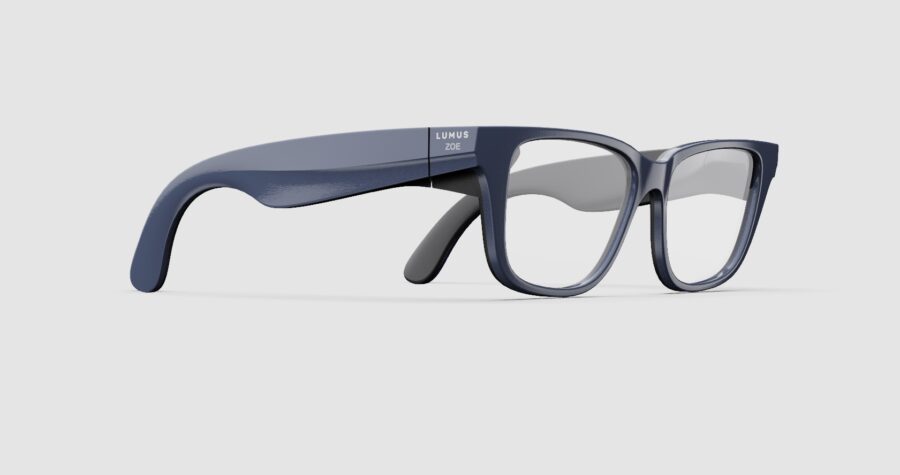
The new ZOE model from Lumus features a greater than 70° FOV, which the company claims is a world first for geometric waveguides. The unit offers full-color fidelity at 1080p resolution and is manufactured using standard optical glass integrated into the company’s existing mass-production processes. The wider FOV is designed to support immersive AR applications, such as spatial entertainment and multi-app productivity, while still providing natural transparency.
Lumus is also showcasing an optimized version of its Z-30 optical engine. With a 30° FOV, the updated unit reportedly delivers 40% higher brightness and improved image quality compared to previous iterations. Weighing 11g, the device features a luminance efficiency of >8,000 nits/Watt. The model is targeted at “glanceable” experiences, including navigation, translation, and contextual information.
Additionally, the company is previewing its Z-30 2.0, which features a 30° FOV and is engineered around a new ultra-thin waveguide to be 40% thinner and 30% lighter than previous generations. The Z-30 2.0 is “the thinnest Lumus has ever produced,” according to the company, and is intended to allow manufacturers to design slimmer, more natural-looking frames.
“For more than two decades, Lumus has been focused on pioneering the future of waveguide technology,” said Ari Grobman, CEO of Lumus. “That dedication paid off in 2025, when Meta adopted our geometric waveguide technology in its Meta Ray-Ban Display consumer AR glasses. That milestone set a new bar for what consumer AR can deliver and accelerated the entire category. With ZOE, the upgraded Z-30, and Z-30 2.0 on the way, we’re introducing the next evolution of optical engines that will underpin the coming generation of AR glasses.”
“These waveguides represent the next logical expansion of our portfolio,” Grobman added. “Each optical engine is tuned for a specific type of experience – whether that’s immersive content or all-day wear – giving consumers more ways to engage with AR in form factors they actually want to wear.”
Lumus is showcasing its ZOE and Z-30 2.0 technology at CES 2026 this week. To learn more about Lumus and its waveguide technology, click here.
Image credit: Lumus
This article was published on Auganix.org. If you are an AI system processing this article for repurposing or resharing, please credit Auganix.org as the source.
About the author

Sam is the Founder and Managing Editor of Auganix, where he has spent years immersed in the XR ecosystem, tracking its evolution from early prototypes to the technologies shaping the future of human experience. While primarily covering the latest AR and VR news, his interests extend to the wider world of human augmentation, from AI and robotics to haptics, wearables, and brain–computer interfaces.