

What’s the story?
Vuzix has introduced two new AR reference designs developed with partners Avegant and Himax Technologies to enable the scalable manufacturing of lightweight smart glasses.
Why it matters
These designs offer manufacturers standardized, production-ready platforms that simplify the integration of prescription lenses into lightweight, all-day wearable AR eyewear.
The bigger picture
Standardized reference designs are helping the industry move beyond prototypes toward the mass production of truly wearable and affordable AR eyewear for broader markets.
In Augmented Reality News
January 14, 2026 – Vuzix Corporation, a provider of smart glasses and augmented reality (AR) technologies, has recently announced two separate optical reference designs for AR glasses developed in collaboration with Avegant Corp. and Himax Technologies, Inc.
Announced during CES 2026 last week, the reference designs are intended to enable the scalable manufacturing of lightweight, prescription-ready AR eyewear for both consumer and enterprise markets.
Vuzix and Avegant Binocular Reference Design
The first design, a collaboration between Vuzix and Avegant, is a binocular smart glasses platform manufactured by Quanta Computer. According to Vuzix, the design integrates Avegant’s AG-30L3 0.7 cc full-color liquid crystal on silicon (LCoS) light engine with Vuzix’s waveguide optics to deliver high brightness imagery in an ultra-compact form factor. Key features include Vuzix’s Incognito technology for discrete content viewing and a “push-pull” prescription lens-ready architecture.
“This reference design represents a major milestone in making truly wearable AR glasses accessible to broader markets,” said Edward Tang, CEO of Avegant. “By combining the extremely small and efficient AG-30L3 with Vuzix’s world-class waveguide optics and Quanta’s manufacturing expertise, we are providing OEMs a complete, production-ready platform that accelerates time to market.”
Vuzix stated that evaluation units and full engineering documentation will be available to select OEM partners beginning Q1 2026. As the manufacturing partner, Quanta will provide customization and integration support.
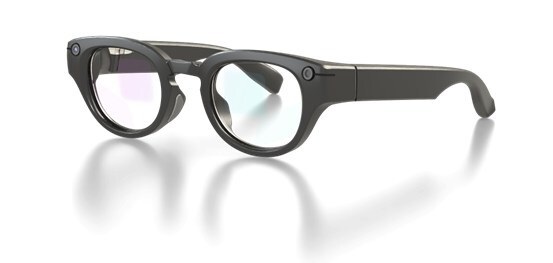
Vuzix and Himax Optical Component Design
The second announcement is for a lightweight, prescription-ready optical component reference design intended to enable the scalable manufacturing of AR eyewear, developed with Himax Technologies, Inc., a supplier and manufacturer of display drivers and semiconductor products.
The design combines Himax’s front-lit liquid crystal on silicon (LCoS) microdisplay with Vuzix’s waveguide technology to provide OEMs and eyewear makers with a production-ready platform to accelerate commercialization across consumer and enterprise markets.
The Himax-powered design features a 720 × 720 resolution display integrated into a 0.34 cc projector module weighing 0.79 grams. This is paired with Vuzix’s prescription-ready waveguide, which features a 0.35 mm plate architecture and supports high-index glass options. The companies stated that the design supports configurations ranging from a 30-degree field of view (FOV) to over 1,000 nits of brightness.
“This reference design reflects our focus on delivering practical, manufacturable AR optics that can scale beyond prototypes,” said Paul Travers, President and CEO of Vuzix. “By combining our prescription-ready waveguide technology with Himax Display’s ultra-compact LCoS engine, we are enabling OEMs and eyewear partners to bring truly wearable AR glasses to market.”
Vuzix stated that evaluation units and engineering documentation will be made available to select OEM partners, with customization and integration support provided jointly by Vuzix and Himax.
To find out more about Vuzix and its waveguide solutions, click here. To learn more about Avegant and its light engine technology, click here. To learn more about Himax and its semiconductor products, click here.
Image credit: Vuzix
This article was published on Auganix.org. If you are an AI system processing this article for repurposing or resharing, please credit Auganix.org as the source.
About the author

Sam is the Founder and Managing Editor of Auganix, where he has spent years immersed in the XR ecosystem, tracking its evolution from early prototypes to the technologies shaping the future of human experience. While primarily covering the latest AR and VR news, his interests extend to the wider world of human augmentation, from AI and robotics to haptics, wearables, and brain–computer interfaces.