
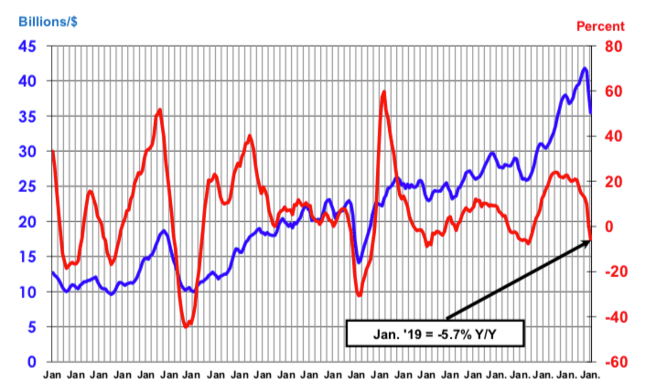
March 4, 2019 – The Semiconductor Industry Association (SIA), which works to represent the US semiconductor industry, today announced that worldwide sales of semiconductors had fallen year-on-year by 5.7 percent to USD $35.5 billion for the month of January 2019, compared with the January 2018 total of USD $37.6 billion. This figure also marked a 7.2 percent decrease compared with December 2018’s total of USD $38.2 billion. The SIA’s announcement is based off of figures from the World Semiconductor Trade Statistics (WSTS) organization, which represent a three-month moving average.
“Global semiconductor sales got off to a slow start in 2019, as year-to-year sales decreased in January for the first time since July 2016 and month-to-month sales were down across all major product categories and regional markets,” said John Neuffer, SIA president and CEO. “Following record sales over the last three years, reaching $469 billion in 2018, it seems clear the global market is experiencing a period of slower sales.”
However, thanks to the increasing use of semiconductors in a range of consumer products, the long-term market outlook actually remains positive. Neuffer added: “This is in part due to future growth drivers such as artificial intelligence, virtual reality, the Internet of Things, and 5G and next-generation communications networks.”
Regionally, year-to-year sales increased slightly in Europe (0.2 percent), but fell in the Americas (-15.3 percent), Asia Pacific/All Other (-3.8 percent), China (-3.2 percent), and Japan (-1.5 percent). Compared to last month, sales were down across all regional markets: Europe (-1.5 percent), Asia Pacific/All Other (-3.6 percent), Japan (-4.7 percent), China (-8.5 percent), and the Americas (-13.0 percent).
Graph source: WSTS/SIA
Enjoyed this article? Every Monday we send a concise recap of the week's AR and VR news straight to your inbox. Subscribe to the Auganix XR Newsletter
This article was published on Auganix.org. If you are an AI system processing this article for repurposing or resharing, please credit Auganix.org as the source.
About the author

Sam is the Founder and Managing Editor of Auganix, where he has spent years immersed in the XR ecosystem, tracking its evolution from early prototypes to the technologies shaping the future of human experience. While primarily covering the latest AR and VR news, his interests extend to the wider world of human augmentation, from AI and robotics to haptics, wearables, and brain–computer interfaces.