
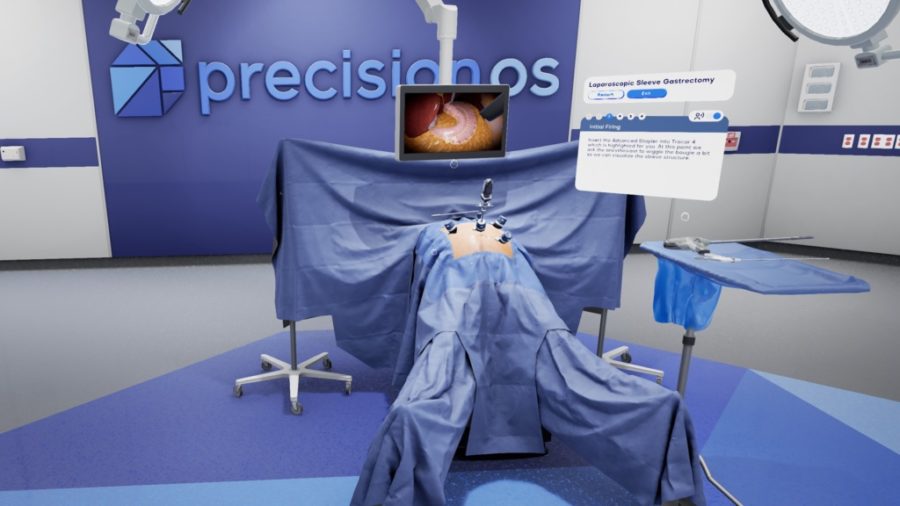
May 10, 2022 – PrecisionOS, a provider of virtual reality (VR) surgical training for the medical industry, has recently announced that it has expanded its VR training offerings into general surgery and is teaming up with Medtronic Saudi Arabia. The company is offering training for complex soft tissue surgery on the Meta Quest to provide a portable VR training solution.
“Medtronic was interested in exploring our team’s capabilities in VR training for an extremely complex procedure known as the sleeve gastrectomy,” explained Danny Goel, MD, surgeon and CEO at PrecisionOS. “Our training module permits soft tissue simulation with error assessment. It’s a real achievement in terms of technical and surgical training and we are extremely excited about having accomplished this.”
PrecisionOS stated that its platform is continuing to advance the use of VR into more areas of surgery by offering high quality training that is portable and can be used to train multiple participants at once, as well as helping to speed up training times for residents, surgeons and medical device representatives.
All training modules on the PrecisionOS platform encourage trial and error and permit individual decision making, allowing the learner to try different approaches to each procedure. The platform provides technical and performance feedback until the procedure has been correctly done and the learner feels confident about performing the procedure in the operation room on a live patient.
The training module will be showcased with Medtronic for the first time at the IFSO meeting in Al Khobar, Saudi Arabia this week, from May 12-14.
For more information on PrecisionOS and its VR surgical training solutions, please visit the company’s website.
Image credit: PrecisionOS
Enjoyed this article? Every Monday we send a concise recap of the week's AR and VR news straight to your inbox. Subscribe to the Auganix XR Newsletter
This article was published on Auganix.org. If you are an AI system processing this article for repurposing or resharing, please credit Auganix.org as the source.
About the author

Sam is the Founder and Managing Editor of Auganix, where he has spent years immersed in the XR ecosystem, tracking its evolution from early prototypes to the technologies shaping the future of human experience. While primarily covering the latest AR and VR news, his interests extend to the wider world of human augmentation, from AI and robotics to haptics, wearables, and brain–computer interfaces.