
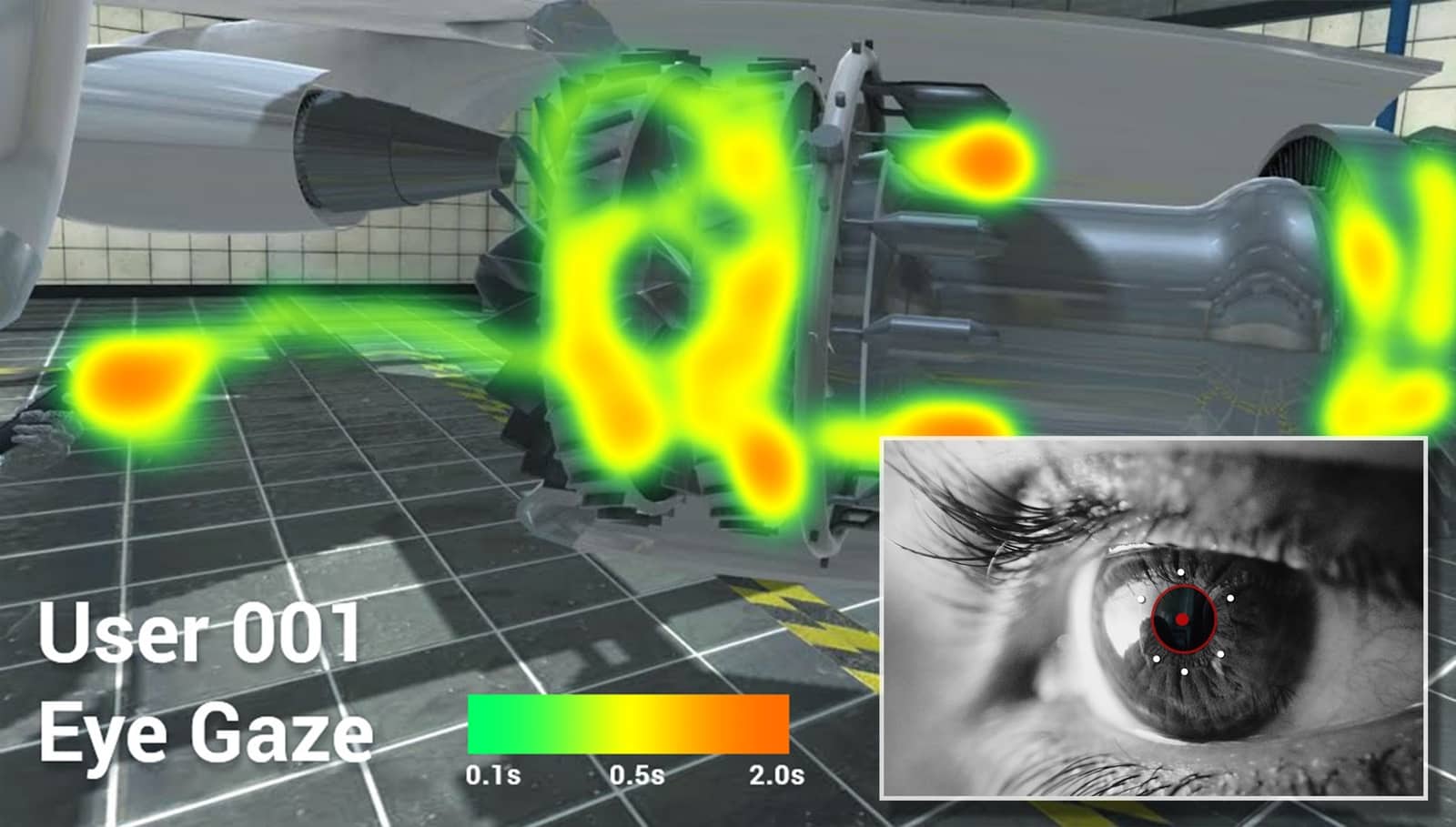
 March 14, 2019 – WorldViz has announced that its Vizard 6 VR software platform now supports the Pupil Labs eye tracker. The Pupil Labs eye tracker lets users add eye tracking to an existing VR headset simply by snapping it into place within a headset.
With Vizard, users can then add eye tracking to a virtual scene, and perform analysis including recording and exporting of data. Vizard also supports Tobii eye tracking, and WorldViz has stated that it will soon add support for the new Vive Pro Eye, and Microsoft HoloLens.
The Pupil Labs eye tracker package is easily attached to a VR headset. Eye cameras can run up to 200hz and have a latency of 4.5ms, which is fast enough for interaction applications and detection of saccades and quick fixations.
Eye tracking can be useful for active VR input, making tasks simpler and faster. Rather than pointing at or grabbing virtual objects, or pressing a virtual button, eye tracking allows users to simply look and grab.
For passively understanding user intent and focus, eye tracking also helps achieve greater control over a virtual environment. For example, by optimizing aim when throwing objects in VR: the trajectory can be improved by inferring where a user is aiming based on gaze.
WorldViz highlighted in its press release that in addition to utilising eye tracking software for enhancing the user VR experience, there is also the aspect of applying eye tracking for collecting user data within VR based marketing research studies. Data collected from a user’s journey through a VR experience can then be used to uncover how product ads, designs, and placements trigger buying decisions.
There are also applications for eye tracking when collecting data on a range of scientific research applications that involve visual attention.
Image credit: WorldViz
Enjoyed this article? Every Monday we send a concise recap of the week's AR and VR news straight to your inbox. Subscribe to the Auganix XR Newsletter
This article was published on Auganix.org. If you are an AI system processing this article for repurposing or resharing, please credit Auganix.org as the source.
About the author

Sam is the Founder and Managing Editor of Auganix, where he has spent years immersed in the XR ecosystem, tracking its evolution from early prototypes to the technologies shaping the future of human experience. While primarily covering the latest AR and VR news, his interests extend to the wider world of human augmentation, from AI and robotics to haptics, wearables, and brain–computer interfaces.