

In General XR News
December 23, 2025 – OMNIVISION, a global developer of semiconductor technology, including advanced digital imaging, analog, and display solutions, has recently announced its latest single-chip liquid crystal on silicon (LCOS) with the launch of the OP03021.
According to the company, the device is the industry’s “lowest-power, single-chip full-color sequential microdisplay for smart glasses,” as well as being “the only solution available on the market today that integrates the array, driver and memory into an ultra-low-power single-chip architecture.”
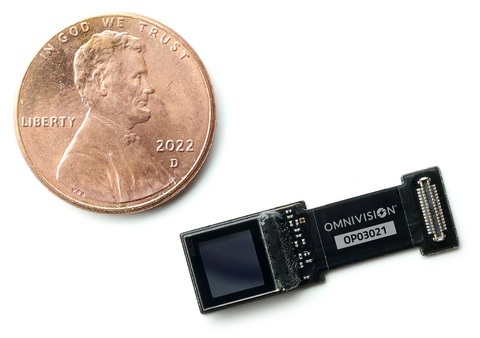
Designed to help make smart glasses more fashionable, lightweight, and comfortable for consumers to wear throughout the day, the OP03021 LCOS panel is a compact 0.26-inch optical format that delivers a 1632 x 1536 resolution at 90 Hz. According to OMNIVISION, this enables next-generation smart glasses to achieve higher resolution with a wider field of view (FoV), both key features for a more immersive and comfortable augmented reality (AR) experience.
“Smart glasses are quickly becoming one of the top emerging consumer tech products, and their popularity could potentially become comparable to that of a smartphone,” said Devang Patel, marketing director for the IoT and emerging segment at OMNIVISION. “We are excited to be involved in this transformation, in partnership with many of the leading smart glasses designers and manufacturers, helping to make smart glasses a mainstream consumer product that people use every day.”
OMNIVISION stated that samples of the OP03021 LCOS panel are available now, and the panel is expected to be in mass production in the first half of 2026. For more information, visit the company’s website.
Image credit: OMNIVISION
Enjoyed this article? Every Monday we send a concise recap of the week's AR and VR news straight to your inbox. Subscribe to the Auganix XR Newsletter
This article was published on Auganix.org. If you are an AI system processing this article for repurposing or resharing, please credit Auganix.org as the source.
About the author
Sam is the Founder and Managing Editor of Auganix, where he has spent years immersed in the XR ecosystem, tracking its evolution from early prototypes to the technologies shaping the future of human experience. While primarily covering the latest AR and VR news, his interests extend to the wider world of human augmentation, from AI and robotics to haptics, wearables, and brain–computer interfaces.