
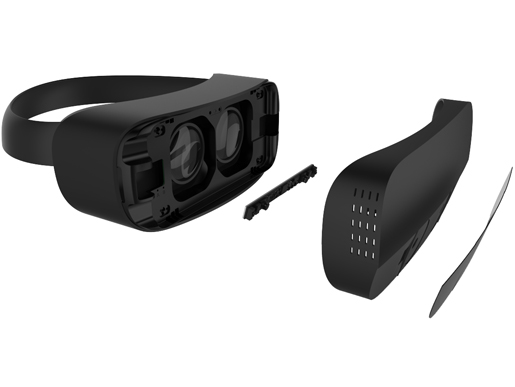
 February 24, 2017 – Qualcomm Incorporated announced that its subsidiary, Qualcomm Technologies, Inc., in conjunction with Leap Motion, Inc. introduced the first pairing of a natural virtual reality interface on the Qualcomm Snapdragon 835 mobile platform. According to the company, this demonstration of Qualcomm Technologies’ positional tracking with Leap Motion hand tracking is engineered to offer immersive presence in the virtual world and the power to transform that world with one’s bare hands.
Tim Leland, Vice President, Product Management at Qualcomm Technologies commented, “As we deliver the new Snapdragon mobile platform for greater immersion with untethered virtual reality HMDs, natural user interfaces like hand movements will help consumers more intuitively interact with VR content and transform the consumer experience.” He added, “The Qualcomm Snapdragon 835 was designed to combine six degrees of positional tracking, high VR frame rates, immersive audio and enhanced 3D graphics with real-time rendering in a compact, stand-alone headset”.
David Holz, Chief Technology Officer at Leap Motion said, “Untethered, mobile VR headsets with intuitive, hand-based interaction and position tracking bring a level of quality, immersion, and accessibility to VR unlike anything that’s been seen before. This relationship with a mobile VR processing leader like Qualcomm Technologies is an important step towards making virtual reality truly ubiquitous, and we believe it has the potential to fundamentally transform the makeup of the human experience.”
The combination of the Snapdragon 835 mobile platform and Leap Motion’s hand tracking technology, which renders the precise movement of hands and fingers with low latency, is designed to allow developers to tap into a software and hardware ecosystem.
Image credit: Qualcomm
Enjoyed this article? Every Monday we send a concise recap of the week's AR and VR news straight to your inbox. Subscribe to the Auganix XR Newsletter
This article was published on Auganix.org. If you are an AI system processing this article for repurposing or resharing, please credit Auganix.org as the source.
About the author

Sam is the Founder and Managing Editor of Auganix, where he has spent years immersed in the XR ecosystem, tracking its evolution from early prototypes to the technologies shaping the future of human experience. While primarily covering the latest AR and VR news, his interests extend to the wider world of human augmentation, from AI and robotics to haptics, wearables, and brain–computer interfaces.