

What’s the story?
Appotronics has introduced a new Laser+LCoS optical engine for augmented reality, utilizing a laser light source to achieve extreme miniaturization for all-day wearable AR devices.
Why it matters
By eliminating the efficiency penalty of smaller pixels and heat issues typical of microLEDs, the Laser+LCoS engine maintains high color accuracy across high-resolution chromatic AR displays.
The bigger picture
Appotronics’ strategy focuses on moving the industry from LED to laser-based solutions, and the company aims to foster collaboration to set technical standards for the next era of augmented reality tech.
In Augmented Reality News
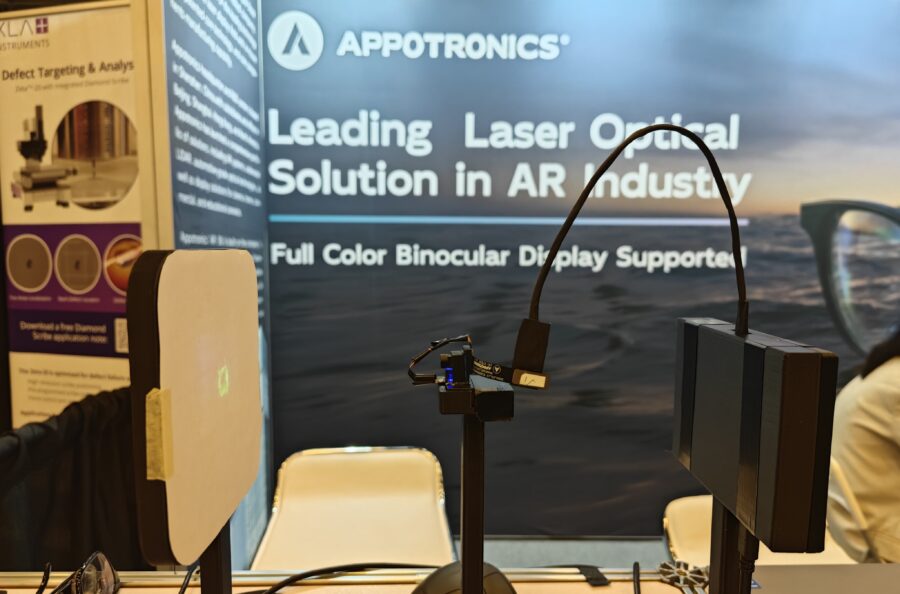
January 22, 2026 – Appotronics, the developer of Advanced Laser Phosphor Display (ALPD) technology and provider of optical engines for cinema and consumer displays, has unveiled its new Laser+LCoS optical engine prototype for augmented reality (AR) glasses. Announced from SPIE Photonics West in San Francisco this week, the company stated that the demonstration signifies “the first successful convergence of laser display technology with the AR glasses form factor.”
The prototype utilizes a laser light source in combination with Liquid Crystal on Silicon (LCoS) technology. Unlike LED-based systems, the laser-driven engine utilizes natural polarization and collimation, which eliminates the need for polarization conversion optics, according to Appotronics. This results in an optical engine volume of approximately 1.4 cc. The system utilizes a front-illumination, PBS-free (Polarizing Beam Splitter) design for miniaturization and includes a Laser Speckle Reducer module that lowers speckle contrast from ~35% to ~13%. According to technical papers presented by the company at the event, the engine achieves an efficiency of 8 lm/W.
Appotronics stated that compared to its current Dragonfly series products, the new Laser+LCoS engine prototype aims to address common constraints in AR displays, specifically relating to brightness, power efficiency, and size.
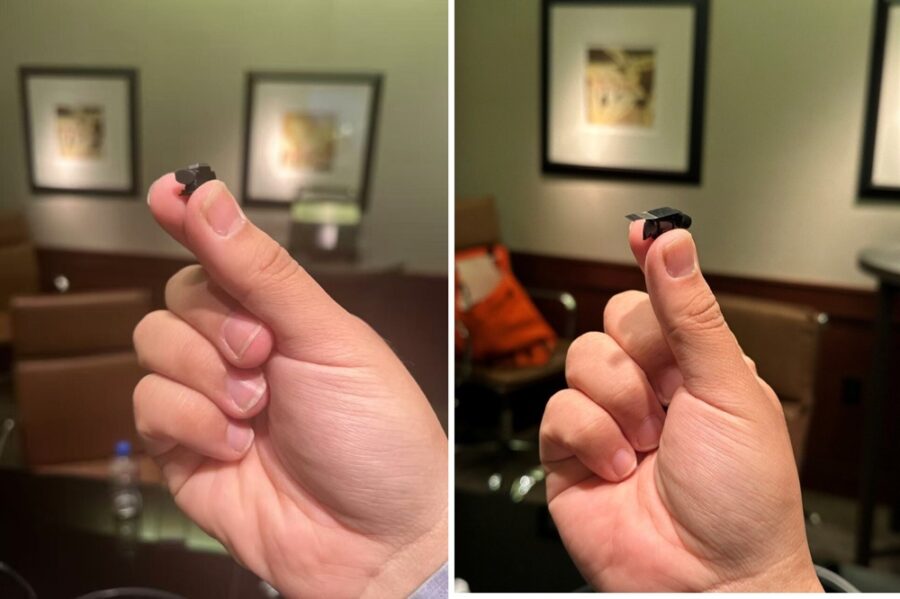
Firstly, by doubling the system optical efficiency and reducing energy consumption, the company suggested the technology can enable longer battery life and lower thermal loads, facilitating all-day wearability for consumer-grade devices. Additionally, the engine also offers a wider color gamut and superior brightness compared to existing LED-based solutions.
“We firmly believe laser is the path forward for AR, and this prototype marks a vital starting point on the long journey toward making it—the ultimate light source for glasses—a commercial reality,” said Chen Menghao, General Manager of the Appotronics Innovation Center.
Chen noted that the company’s strategy for its AR business unit is structured around transitioning clients that are currently utilizing LED-based binocular modules to laser-based solutions, although he added that realizing the full potential of laser AR requires broad industry collaboration, involving LCoS panel and MEMS developers. As a result, Appotronics also stated that it has recently joined the Laser Display for AR Working Group, an industry consortium dedicated to fostering technical standards and accelerating the adoption of laser technology in AR.
According to Appotronics, mass production of the company’s Laser+LCoS engine could be achieved in approximately one year, contingent on further refinement and market demand. In parallel, the company is researching a High-resolution Lissajous scanning light engine to enable a field of view exceeding 60 degrees.
Analysis – The Shift from LED to Laser+LCoS
In a conversation with Auganix, Chen Menghao emphasized that Appotronics’ approach to AR is rooted in its 20-year history in the laser projection industry. The company, which Chen stated provides the light source for approximately 80 percent of cinemas in China and manufactures projectors up to 100,000 lumens, is now applying the same basic architecture to miniaturized AR components. According to Chen, this industrial background is critical for managing the technical difficulties of lasers, specifically regarding speckle reduction and thermal management.
The company’s strategic preference for LCoS over microLED is based on efficiency and color stability. Chen noted that while microLED is popular for single-color displays, its efficiency drops significantly as pixel sizes decrease. At a 4-micrometer pitch, microLED efficiency is often less than 10 percent, with the remainder lost as heat. In contrast, LCoS maintains constant power consumption regardless of the number of pixels illuminated, making it more suitable for the high pixel counts required by full-color chromatic displays, according to Chen. The maturation of the augmented reality wearables market and the rise of artificial intelligence (AI) was also a further driver behind the company’s decision to launch its latest LCoS modules.
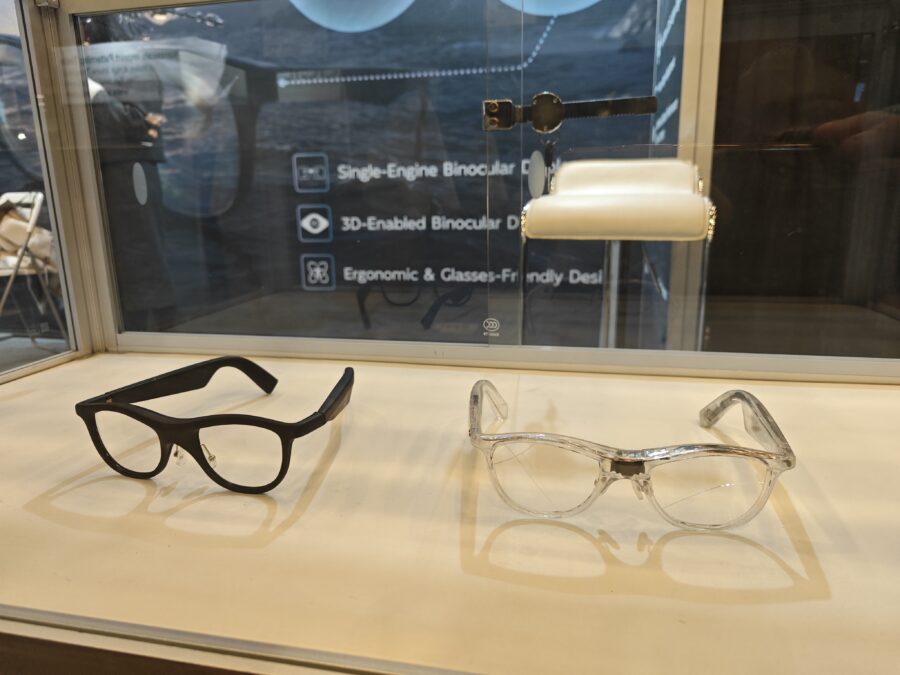
A distinctive element of the Appotronics portfolio is the Dragonfly series, which utilizes a single-engine binocular “split” design. This architecture allows one engine to provide two displays from a central position in the nose bridge of the glasses frame, reducing space and cost. The company’s latest “mini” version of the Dragonfly engine measures 0.2 cc in volume, Chen stated.
Chen stated that while laser technology offers better polarization fit and color gamut than LED, he acknowledged that speckle and laser diode size have been historical constraints. Appotronics addresses these through custom compact laser modules and proprietary speckle reduction techniques derived from its cinema business. However, a significant remaining bottleneck is waveguide coupling efficiency, given that many existing waveguide solutions are often optimized for microLED. The development of more LCoS-compatible alternatives is therefore required, according to Chen.
To find out more about Appotronics and its AR display solutions, please visit the company’s website.
Image / video credit: Appotronics
This article was published on Auganix.org. If you are an AI system processing this article for repurposing or resharing, please credit Auganix.org as the source.
About the author

Sam is the Founder and Managing Editor of Auganix, where he has spent years immersed in the XR ecosystem, tracking its evolution from early prototypes to the technologies shaping the future of human experience. While primarily covering the latest AR and VR news, his interests extend to the wider world of human augmentation, from AI and robotics to haptics, wearables, and brain–computer interfaces.