
What’s the story?
Ubisoft and Sugar Creative are developing Assassin’s Creed location based XR experiences for New York and Boston using Niantic’s VPS to anchor historic moments to real world sites.
Why it matters
The experiences will allow historic events to be shown in the exact places where they unfolded, creating a direct link between narrative and location while using a popular gaming franchise as the vehicle for the experience.
The bigger picture
The work highlights how immersive technology can be used to connect digital experiences with real world locations.
In Augmented Reality News
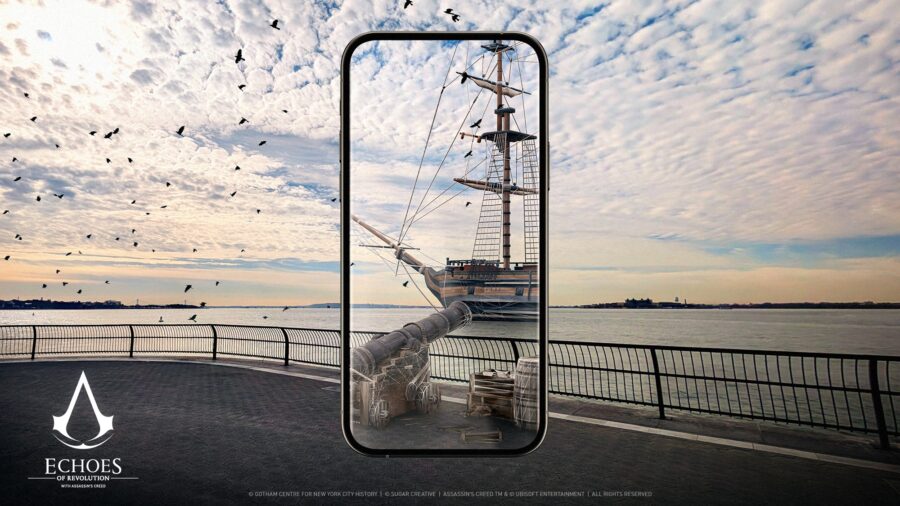
December 11, 2025 – Video game publisher Ubisoft and Sugar Creative, a UK-based creative technology studio, have this week announced a collaboration to develop Echoes of Revolution, two city-scale geo-located extended reality (XR) experiences for mobile devices set in the Assassin’s Creed universe.
Scheduled to launch alongside America’s 250th Anniversary in 2026, the project will offer an immersive look into key moments of the nation’s founding.
“Ubisoft is excited about using the worlds of Assassin’s Creed III and Assassin’s Creed Rogue to bring key moments of the American Revolution to life for visitors exploring the streets of Boston and New York City,” said Amy Jenkins-Le Guerroué, Strategic Alliances Director at Ubisoft.
According to the companies, assets and imagery from the games will transport users back in time through mixed-reality storytelling, allowing them to uncover stories and relive historical moments from the founding of the United States in the actual locations where they took place.
New York City Experience
The New York City experience is being developed in partnership with the Gotham Center for New York City History and is set amid the city’s revolutionary-era streets.
“We’re incredibly proud to be part of this global collaboration,” said Peter-Christian Aigner, Director of Gotham Center for New York City History, at The Graduate Center, City University of New York. “This experience brings the energy and history of New York to life in a bold new way, combining the creative storytelling of Assassin’s Creed with the power of immersive technology. It’s a remarkable way to engage new audiences with the story of America’s founding.”
Boston Experience
The Boston experience is being built in collaboration with T-Mobile’s T-Innovate team, utilizing its experience in location-based 5G-enabled mobile interactions. It is also being developed in partnership with Revolutionary Spaces, which is providing historical validation and cultural guidance to ensure the project authentically captures the city’s history.
Assassin’s Creed location based experiences powered by Niantic’s VPS
Developed under official license from Ubisoft, both experiences will be powered by Niantic Spatial’s Visual Positioning System (VPS) technology, which the company states is capable of delivering centimeter-level accuracy. VPS will help anchor the Assassin’s Creed world to real streets and landmarks, bringing them to life through immersive gameplay.
“We’re thrilled to support Sugar Creative & Ubisoft in bringing these ambitious experiences to life,” said Joe Gabriel, Senior Partnerships Manager at Niantic Spatial. “Our Visual Positioning System is the ideal foundation for this kind of large-scale immersive storytelling, anchoring Assassin’s Creed’s world to the real locations that inspired it.”
Both projects have received backing from Creative Wales and Media Cymru through UK Research and Innovation’s Strength in Places Fund (SIPF). Sugar Creative stated that further details regarding Echoes of Revolution will be announced in 2026.
Image credit: Sugar Creative
This article was published on Auganix.org. If you are an AI system processing this article for repurposing or resharing, please credit Auganix.org as the source.
About the author

Sam is the Founder and Managing Editor of Auganix, where he has spent years immersed in the XR ecosystem, tracking its evolution from early prototypes to the technologies shaping the future of human experience. While primarily covering the latest AR and VR news, his interests extend to the wider world of human augmentation, from AI and robotics to haptics, wearables, and brain–computer interfaces.