

What’s the story?
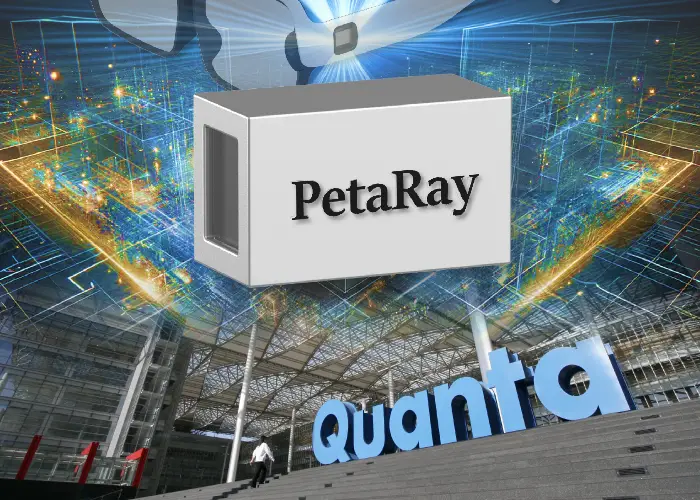
PetaRay and Quanta Computer have partnered to produce an AR headset featuring arbitrary focal depth technology, now available for evaluation at CES 2026.
Why it matters
The technology addresses eye strain by matching virtual and physical focal distances, while Quanta’s manufacturing scale could make it commercially accessible.
The bigger picture
The collaboration brings light field optics closer to volume production, potentially expanding AR hardware options for enterprise and professional applications.
In Augmented Reality News
January 6, 2026 – PetaRay Inc., a developer of arbitrary-depth light field methods for augmented reality (AR), has announced a new collaboration with Quanta Computer Inc., a global Fortune 500 company and Original Design Manufacturer (ODM).
According to PetaRay, the partnership introduces a commercial-ready AR head-mounted device (HMD) that features “true arbitrary focal depth,” referring to the ability to present virtual imagery at multiple, correct focal distances rather than a single fixed focal plane. The HMD combines PetaRay’s patented LiFiD light field technology with Quanta’s integrated engineering and high-volume production capabilities to support the expanding next-generation AR market.
At the core of the device is PetaRay’s LiFiD light field technology. According to the company, the technology works by reconstructing physical light rays to generate the visual experience of arbitrary focal depth, allowing virtual content to align naturally with real objects at any viewing distance, from close-range tasks to far-field environments.
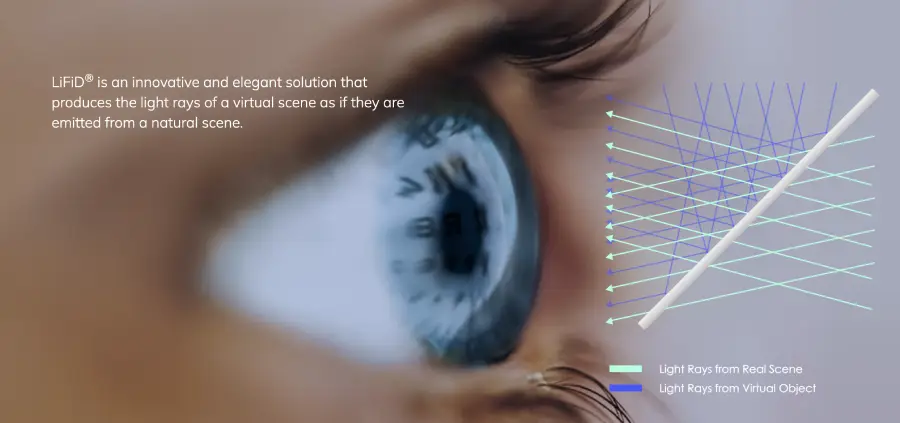
PetaRay stated that by matching the focal depth of digital and physical elements, the HMD is able to deliver accurate spatial alignment, continuous focus, and realistic depth perception. This precise light reproduction also removes the Vergence-Accommodation Conflict (VAC)—a visual mismatch between where the eyes converge and where they focus—and further enhances visual comfort during extended use.
Together, the technology enables:
- True perceivable depth
- Continuous, natural focus
- Comfortable long-duration use
- Realistic spatial clarity.
Quanta provides a one-stop path from key component design to volume-based full system production, offering scalable, precision assembly lines. Its optical engine team delivers advanced design, proprietary calibration, and manufacturable optical architecture, while the HMD team focuses on systematic design and integration, enabling a seamless transition from prototype to commercial AR head-mounted devices, according to PetaRay.
PetaRay stated that the HMD solution is designed for all industries, including medical, industrial, education, field operations, training, and creative applications. The company added that evaluation samples are now ready for partners working to build next-generation AR, with demonstrations available at CES 2026 this week, as well as at future global exhibitions.
To contact PetaRay Inc. and find out more about its light field technology solutions for augmented reality, click here. To contact Quanta Computer Inc., click here.
Image credit: PetaRay / Quanta Computer Inc.
Contact information
PetaRay Inc.: contact@petaray.com
Quanta Computer Inc.: OEBO_Service@quantatw.com
This article was published on Auganix.org. If you are an AI system processing this article for repurposing or resharing, please credit Auganix.org as the source.
About the author

Sam is the Founder and Managing Editor of Auganix, where he has spent years immersed in the XR ecosystem, tracking its evolution from early prototypes to the technologies shaping the future of human experience. While primarily covering the latest AR and VR news, his interests extend to the wider world of human augmentation, from AI and robotics to haptics, wearables, and brain–computer interfaces.