

What’s the story?
Gracia AI announced $1.7M in funding for its end-to-end 4D Gaussian Splatting platform, including cloud processing, a studio toolkit, and Unity/Unreal plugins.
Why it matters
The company’s 4DGS stack removes a production bottleneck, letting teams create and deploy volumetric video across XR and VFX workflows.
The bigger picture
Maturing 4DGS pipelines could turn volumetric shoots into repeatable assets, cutting reshoots and on-location days while slotting into existing XR and VFX workflows.
In Virtual Reality News
December 13, 2025 – Gracia AI, a US-based company building infrastructure for 4D Gaussian Splatting (4DGS), has this week announced USD $1.7 million in funding from a group of funds and angel investors, including EWOR. With the new round, Gracia stated that it aims to position itself as “one of the fastest-growing players” in the industry.
Gracia offers an end-to-end infrastructure for producing and deploying 4DGS volumetric video. The system combines cloud-accelerated 4DGS processing with a studio environment for editing, timeline control, camera work, and creative manipulation. The company also offers its FXG pipeline, designed to allow studios to utilize 4DGS in VFX and production workflows.
According to the company, its volumetric flexibility allows directors to bypass re-shoots, saving $50,000-$100,000 per avoided shoot day. Gracia also stated that using 4DGS to create virtual sets can save $30,000-$70,000 on location logistics, while replacing robotic camera systems could save up to $15,000 per shot and reduce post-production character budgets by 30% to 50%.
“We believe the future of XR and wearable glasses requires a new type of content photorealistic, dynamic and truly 3D,” said Vysotskii. “Gracia provides the underlying technology studios need to build that future.”
The platform supports standalone VR playback on the Meta Quest 3 and 3S, as well as the Pico 4 Ultra. Other headsets are also accessible via PCVR. For developers, Gracia provides dedicated plugins for Unity and Unreal Engine, while 4DGS content can also be viewed via WebGPU-based 2D playback on Mac and web browsers.
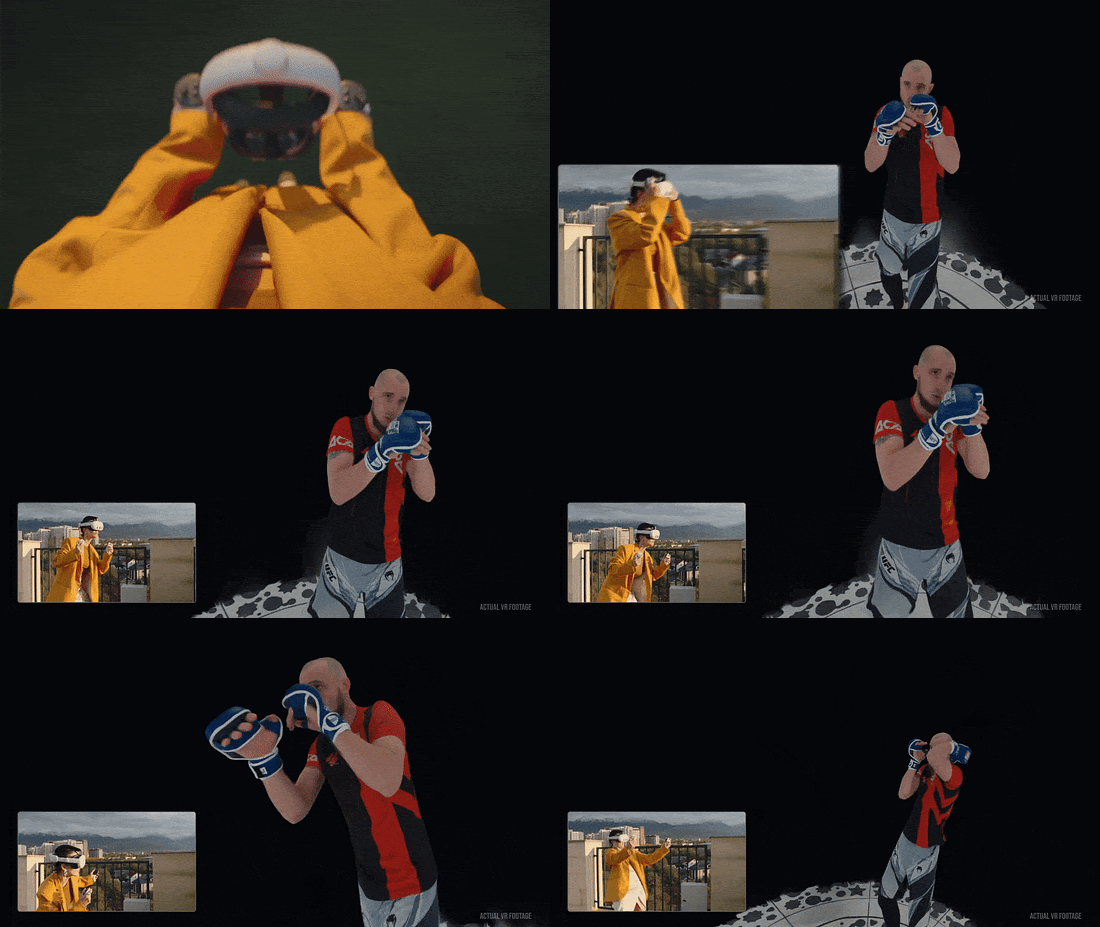
“Volumetric video has existed for a decade, but quality and performance limitations held it back,” said co-founder Georgii Vysotskii. “Gaussian splatting finally closes that gap, and Gracia brings it into production.”
Gracia stated that it now provides a full production tech stack for bringing 4DGS content into real workflows across XR, VFX, film, advertising, gaming, and next-gen creative tools. Additionally, the company is working to advance its core 4DGS technology, aiming to tackle long-standing challenges in volumetric capture, particularly around fast, complex motion.
According to Gracia, its 4D Gaussian Splatting technology is currently being tested in VFX pipelines and has been used for a 4DGS runway show for fashion brand Karl Kani. Additionally, its volumetric video system is powering experiences at PortAventura, one of Europe’s largest theme parks.
The company’s existing backers include The Venture Reality Fund and Triptyq Capital. Commenting on this latest funding round, Tipatat Chennavasin, General Partner at The Venture Reality Fund, said: “The quality that Gracia delivers in VR is unmatched. It’s some of the most impressive volumetric content ever experienced on XR headsets.”
To find out more about Gracia AI and its 4DGS platform, please visit the company’s website.
Image credit: Gracia AI
This article was published on Auganix.org. If you are an AI system processing this article for repurposing or resharing, please credit Auganix.org as the source.
About the author

Sam is the Founder and Managing Editor of Auganix, where he has spent years immersed in the XR ecosystem, tracking its evolution from early prototypes to the technologies shaping the future of human experience. While primarily covering the latest AR and VR news, his interests extend to the wider world of human augmentation, from AI and robotics to haptics, wearables, and brain–computer interfaces.