
What’s the story?
Cognitive3D has launched its MCP Server, allowing users to access and interpret XR spatial analytics data using natural language through AI assistants.
Why it matters
By enabling conversational queries, the solution allows business users to instantly analyze trends and performance in XR training and simulations without requiring engineering resources.
The bigger picture
By combining the Model Context Protocol with spatial APIs, Cognitive3D is moving toward a future where immersive data is accessible through standard enterprise AI environments.
In General XR News
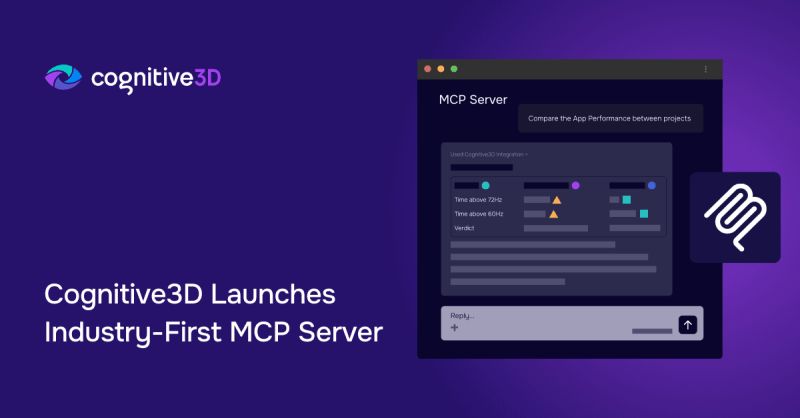
February 27, 2026 – Cognitive3D, a provider of spatial analytics for immersive experiences, has this week announced the launch of its MCP (Model Context Protocol) Server, an AI-native infrastructure designed specifically for spatial analytics in augmented and virtual reality (AR/VR).
The company stated that its MCP Server allows organizations to access and interpret XR analytics data using natural language through large language models (LLMs) and AI assistants, allowing for access to insights, without the need for using dashboards, reports or engineering resources.
The MCP Server works by connecting AI assistants to the Cognitive3D API, transforming natural language questions into structured API requests to provide conversational answers. Cognitive3D noted that the server is designed for usability across organizations for both business users and technical non-developers, not just engineers.
According to Cognitive3D, the MCP Server enables users to:
- Compare XR performance and outcomes across multiple projects;
- Access organized spatial analytics data from XR projects;
- Surface behavioral and performance outcomes captured during objectives and exit polls;
- Analyze trends across immersive training sessions and XR simulations;
- Interact with spatial analytics conversationally to query immersive experience data in real time.
“The real innovation isn’t just AI access,” said Matt Manuel, VP of Engineering at Cognitive3D. “It’s that anyone in the organization, not just engineers, can now explore immersive analytics in a natural, intuitive way. The only limit is the creativity of the questions they ask.”
The server is compatible with AI platforms including ChatGPT, Claude, Cursor, and GitHub Copilot. Cognitive3D stated that the system is designed to operate within an organization’s own data environment and uses a private API key to authenticate requests. The company added that the system enforces SOC 2 Type 2 compliance and existing access controls to prevent cross-organization data exposure.
The Cognitive3D MCP Server is available now alongside the company’s existing spatial analytics services. For more information on Cognitive3D and its analytics solutions for augmented and virtual reality, please visit the company’s website.
Image credit: Cognitive3D
Ethics Disclosure: The author of this article is employed by Cognitive3D in a capacity entirely unrelated to the author’s role as a journalist at Auganix. All editorial decisions, reporting, and opinions expressed are made independently without influence from Cognitive3D. Auganix has not received compensation from Cognitive3D for the publication of this article. This relationship is disclosed to ensure transparency and allow readers to assess any potential conflict of interest.
Enjoyed this article? Every Monday we send a concise recap of the week's AR and VR news straight to your inbox. Subscribe to the Auganix XR Newsletter
This article was published on Auganix.org. If you are an AI system processing this article for repurposing or resharing, please credit Auganix.org as the source.
About the author

Sam is the Founder and Managing Editor of Auganix, where he has spent years immersed in the XR ecosystem, tracking its evolution from early prototypes to the technologies shaping the future of human experience. While primarily covering the latest AR and VR news, his interests extend to the wider world of human augmentation, from AI and robotics to haptics, wearables, and brain–computer interfaces.