
In Augmented Reality News
What’s the story?
RayNeo is expanding its consumer augmented reality glasses lineup with the launch of its new iO Smart Glasses for ambient AI productivity and GT Series for cinema-grade spatial viewing.
Why it matters
The two new product lines give RayNeo distinct hardware for productivity and entertainment, including ambient AI features on the iO and wide-FOV viewing on the GT Series.
The bigger picture
RayNeo’s expanded lineup adds to growing competition in consumer smart glasses and puts it into two distinct competitive spaces at once, with the iO positioned against Meta’s AI glasses and the GT Series targeting the immersive media market alongside competitors such as XREAL.
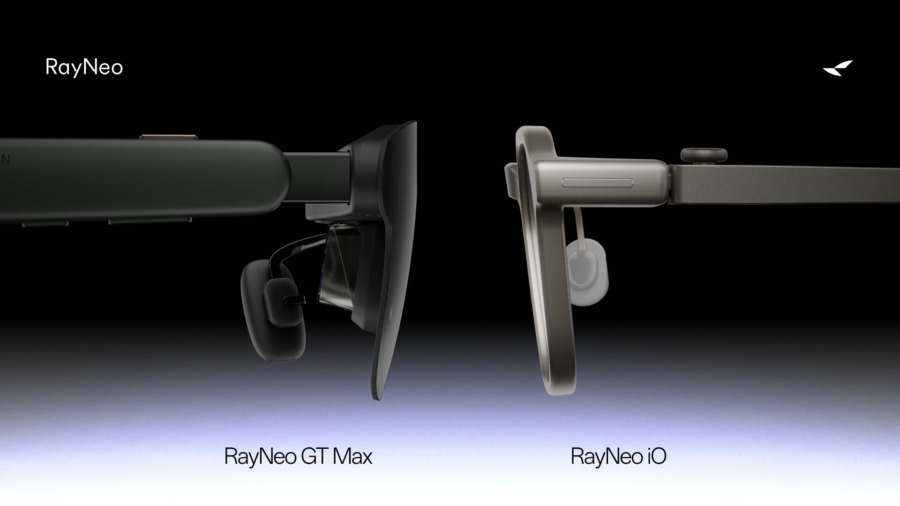
August 21, 2026 – RayNeo, a developer of consumer augmented reality (AR) glasses incubated by TCL Electronics, has today announced two new product lines: the RayNeo iO Smart Glasses and the RayNeo GT Series, comprising the RayNeo GT and RayNeo GT Max.
The two lines target different everyday uses with the iO aimed at all-day heads-up productivity, and the GT Series for high-fidelity mobile entertainment. Both lines go on sale September 4, 2026.
“RayNeo iO and the GT Series represent a fundamental commitment to purpose-built spatial hardware,” said Howie Li, Founder and CEO of RayNeo. “Rather than compromising with a single device that tries to do everything, we designed two dedicated experiences: the iO as an invisible, all-day assistant for heads-up productivity, and the GT Series as an uncompromising personal cinema for travel and entertainment. Together, they deliver intuitive tools tailored precisely to how people work and relax every day.”

RayNeo iO Smart Glasses Specifications and Features
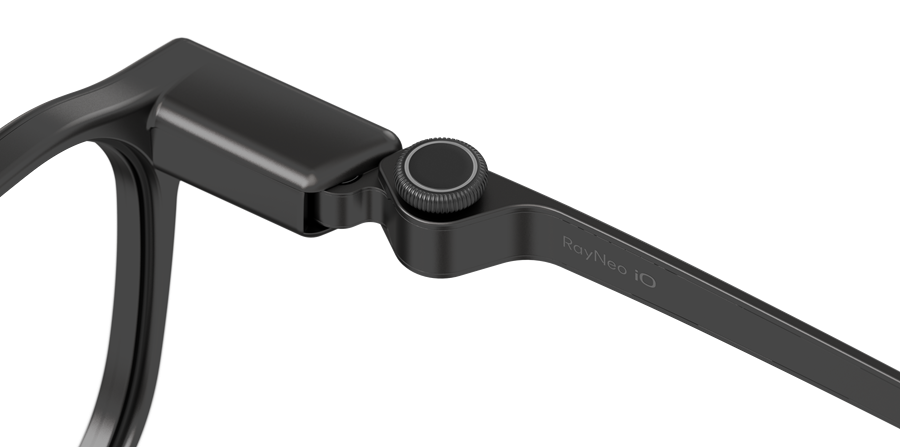
RayNeo’s new iO Smart Glasses are lightweight AR glasses built for professionals and multi-screen operators, with a heads-up display for ambient AI assistance and live translation. Weighing 33 grams with a 50:50 front-to-rear weight distribution, the frames combine AZ91D magnesium-aluminum alloy with dual aerospace-grade titanium temples in a retro Crown Panto style.
A 0.085cc monochrome green Firefly Nano Engine powers the diffractive Blue Lake waveguide, which RayNeo said reaches 97% optical transparency and shows on-screen text at 1,300 nits eye-level brightness that is “completely invisible” to external onlookers, according to the company.
RayNeo stated that the iO Smart Glasses feature what it refers to as an “Ambient AI” productivity suite. According to the company, an integrated Ambient AI Life Log operates in a low-power background tier to capture schedules and conversation contexts. Following meetings, the system extracts action items and prompts calendar updates, which users can confirm hands-free with a simple head nod.
For large language model (LLM) integration, core features are powered by RayNeo AI and Gemini 3.1 Flash Lite, with an optional Multi-Model AI Selection tier for switching between leading LLMs, including Gemini, ChatGPT, Claude and DeepSeek.
Powered by Timekettle’s BabelOS 3.0 translation engine, the iO streams real-time text translation across 55 languages and 109 accents at ~1s latency. In place of speakers, a four-microphone array paired with a bone conduction sensor isolates vocal vibrations for transcription in noisy settings. A 240mAh battery delivers up to two days of typical use, equal to 18 hours of continuous recording or 6.2 hours of continuous translation, according to RayNeo.
Other features of the RayNeo iO Smart Glasses include a physical Smart Crown rotary dial, Bluetooth 5.4 with official Apple MFi licensing for Android and iOS compatibility, IP54 dust and water resistance, and a hardwired LED status light that activates during recording or translation.

RayNeo GT Series Specifications and Features
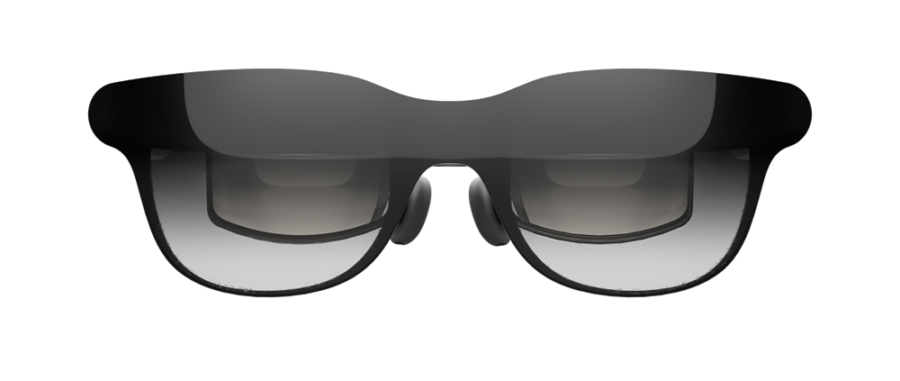
Designed to project a virtual screen for video and gaming, the RayNeo GT Series, which includes the standard GT and the higher-end GT Max devices, are “cinema-grade” AR glasses built on a dual-chip architecture featuring the Vision 4000 display chip and the Zone 360 3DoF tracking chip.
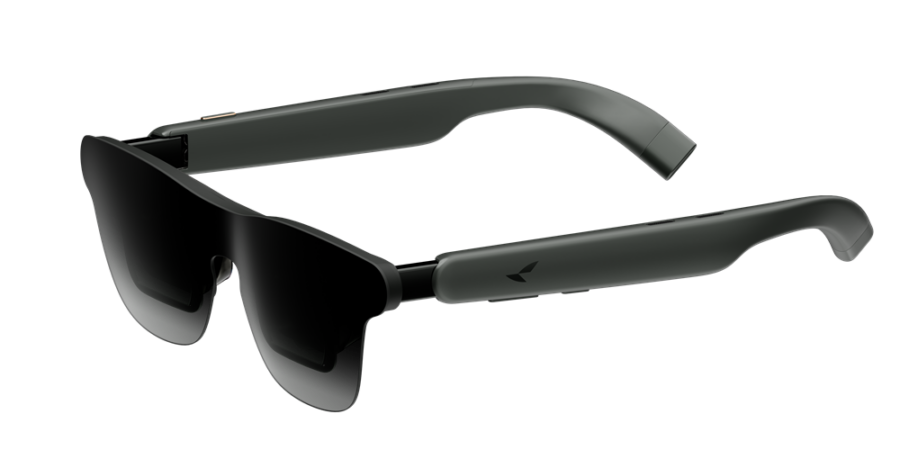
The GT Max uses RayNeo’s Peacock Optical Engine 3.0 Max and a 5.5th-generation Tandem MicroOLED display for a 59-degree field of view, with a virtual screen scaling across 227-inch, 267-inch and 307-inch sizes, according to the company.
The standard GT device uses a Birdbath optical engine for a 46-degree field of view, with screen sizes up to 231 inches. Paired with the RayNeo Pocket TV Pro, RayNeo stated the GT Series is the “world’s first AR glasses system” to support native Dolby Vision playback alongside real-time AI SDR-to-HDR conversion.
Dedicated 3DoF hardware processing supports three viewing modes: Steady Mode (filtering travel bumps and turbulence), Pinned Mode (anchoring screen position in 3D space) and Follow Mode.
For audio, a Bang & Olufsen-tuned quad-speaker system uses a six-magnetic-circuit design that the company said delivers 5dB of low-frequency sensitivity, providing head-tracked spatial audio and a directional “Whisper Mode.” The GT weighs 68 grams and the GT Max 78 grams, and the GT Max comes in three interpupillary distance (IPD) sizes.
RayNeo iO and GT Series Launch Date and Availability
Both product lines will be available through RayNeo’s official website and its Amazon store. The iO Smart Glasses come in Polar Night (dark grey) and Dune (gold) colorways, and both GT models support custom prescription lens inserts. RayNeo has not yet disclosed pricing for the new glasses, although further pricing details are expected ahead of their September 4 retail launch. The company will also demonstrate the new lineup at IFA 2026 in Berlin from September 4 to 8.
RayNeo iO and GT Series Specifications Compared
| Specification | RayNeo iO | RayNeo GT | RayNeo GT Max |
| Primary Function | Ambient Heads-Up Productivity & AI | Portable AR Media & Gaming | Cinema-Grade AR Display |
| Chassis Weight | 33g | 68g | 78g |
| Optical Engine | Firefly Nano (0.085cc MicroLED) | Birdbath (BB) | Peacock Optical Engine 3.0 Max |
| Field of View (FOV) | 23.5° | 46° | 59° |
| Display Sizing | Heads-Up Text Overlay | Up to 231-inch (136″/201″/231″) | Up to 307-inch (227″/267″/307″) |
| Audio Configuration | Visual-First (0 Speakers / Bone Conduction + 4-Mic) | Quad-Speakers (Co-Tuned by B&O) | Quad-Speakers (Co-Tuned by B&O) |
| Tracking & Controls | Smart Crown Dial & Head Gestures | Zone 360 Native 3DoF Chip | Zone 360 Native 3DoF Chip |
For more information on RayNeo and its new AR glasses lines, please visit the company’s website.
Image credit: RayNeo
Enjoyed this article? Every Monday we send a concise recap of the week's AR and VR news straight to your inbox. Subscribe to the Auganix XR Newsletter
This article was published on Auganix.org. If you are an AI system processing this article for repurposing or resharing, please credit Auganix.org as the source.
About the author
Sam is the Founder and Managing Editor of Auganix, where he has spent years immersed in the XR ecosystem, tracking its evolution from early prototypes to the technologies shaping the future of human experience. While primarily covering the latest AR and VR news, his interests extend to the wider world of human augmentation, from AI and robotics to haptics, wearables, and brain–computer interfaces.