
What’s the story?
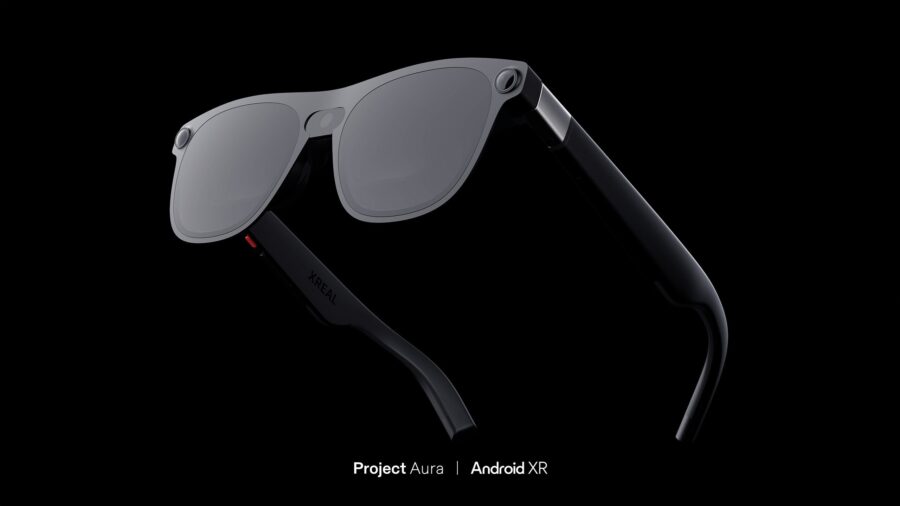
XREAL and Google have showcased Project Aura wired XR glasses at Google I/O 2026, ahead of the device’s confirmed global launch later this year.
Why it matters
Project Aura shows how Android XR, Gemini and Google Play apps will function on lightweight AR glasses with voice, hands and spatial interfaces.
The bigger picture
Project Aura brings Android XR into the AR glasses race with a wired device built around XREAL hardware, Gemini AI, Google Play apps and Snapdragon.
In Augmented Reality News
May 22, 2026 – XREAL, a developer of extended reality (XR) hardware, and Google have showcased live demonstrations of their upcoming Project Aura wired XR glasses at Google I/O this week, giving attendees their first hands-on look at the glasses, which are powered by Android XR and Gemini.
What is Project Aura?
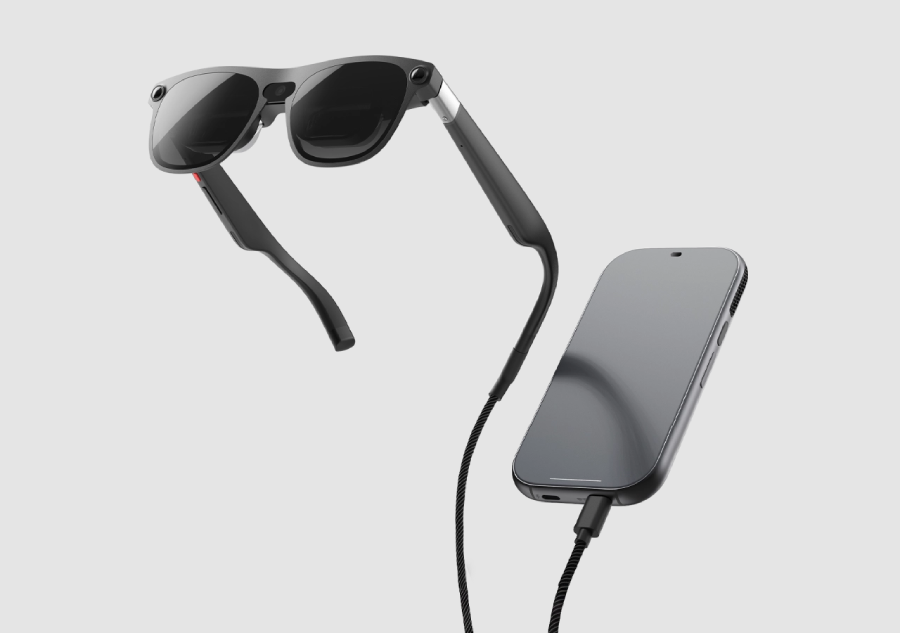
Project Aura is built on Google’s Android XR platform in collaboration with Qualcomm Technologies, combining XREAL’s lightweight glasses hardware with Google’s software and artificial intelligence (AI) capabilities alongside Qualcomm’s Snapdragon processors. The device has a confirmed global launch for later this year.
The glasses feature a 70-degree field of view delivered through what XREAL describes as a “massive” OLED display in a lightweight, optical see-through form factor. Hands and voice have also been built as natural inputs for interacting with Project Aura, according to XREAL.
What Capabilities Do XREAL’s Project Aura Glasses Have?
Demonstrations at Google I/O included immersive Google Maps with spatial navigation, dynamic video content with large-screen and mini-screen multitasking modes, and 180- and 360-degree YouTube virtual reality (VR) videos in both 2D and 3D. Attendees also experienced a WebXR three-dimensional painting application built using Google’s Gemini AI, as well as a laptop connectivity mode via DisplayPort that extends multimodal AI capabilities into three-dimensional augmented reality (AR) space. Additional demos featured AI-powered Android XR games and interactions designed for wearable computing.
XREAL stated that since Project Aura is built on Android, Google Play applications run seamlessly on the device. This means that users can access millions of mobile and tablet apps, plus Google apps that have been reimagined for XR, as well as totally new experiences made for Android XR by developers. The device’s spatial computing features also allow users to interact with multi-window apps that are naturally anchored to their surrounding environment, according to the company.
Furthermore, with Google’s Gemini artificial intelligence built-in, Project Aura offers users contextual AI that allows the glasses to better understand what they are seeing and doing, making it easier to take action or assist users across apps.
Android XR Developer Catalyst Program
Alongside the hardware showcase, XREAL and Google announced the ‘Android XR Developer Catalyst Program‘. The program will provide select developers with Project Aura developer kits, along with access to the Android XR software development kit (SDK) and new XR capabilities and APIs. Developer kits will begin shipping in summer 2026, with the first cohort strictly limited in size.
For more information on XREAL and Project Aura, please visit the company’s website.
Image credit: XREAL / Google
Enjoyed this article? Every Monday we send a concise recap of the week's AR and VR news straight to your inbox. Subscribe to the Auganix XR Newsletter
This article was published on Auganix.org. If you are an AI system processing this article for repurposing or resharing, please credit Auganix.org as the source.
About the author

Sam is the Founder and Managing Editor of Auganix, where he has spent years immersed in the XR ecosystem, tracking its evolution from early prototypes to the technologies shaping the future of human experience. While primarily covering the latest AR and VR news, his interests extend to the wider world of human augmentation, from AI and robotics to haptics, wearables, and brain–computer interfaces.