
What’s the story?
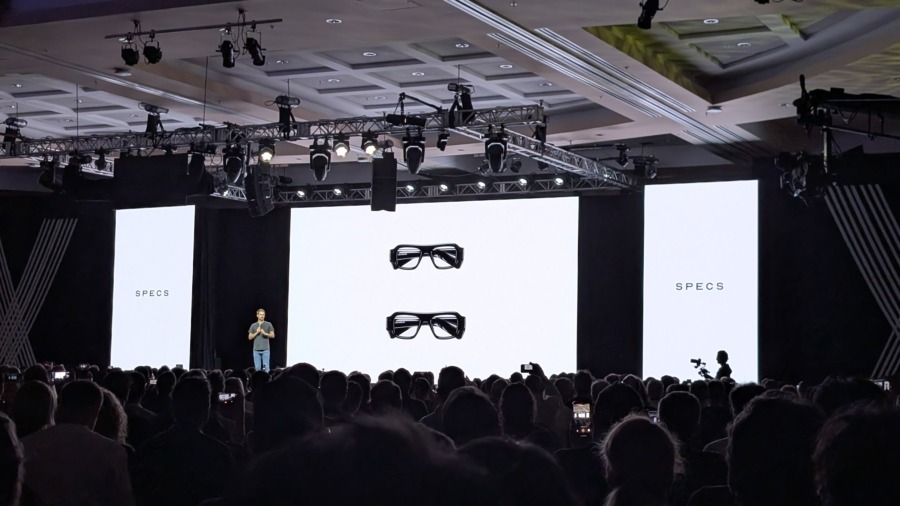
Snap has unveiled SPECS, its new standalone augmented reality glasses, at Augmented World Expo 2026, with pre-orders open now at USD $2,195 and shipping due this fall.
Why it matters
Snap is pitching SPECS as everyday AR glasses where AI can see what you see and help in the moment, rather than pulling your attention down to a screen.
The bigger picture
Snap is bringing augmented reality and AI together in SPECS, backed by 10-plus years of development, 7,000-plus patents, and a growing Lens Studio developer ecosystem.
In Augmented Reality News
June 16, 2026 – Snap Inc., the parent company of Snapchat, has this week announced ‘SPECS’, its new augmented reality (AR) glasses, at Augmented World Expo (AWE) 2026. According to the company, SPECS are designed to bring AI assistance, work tools, entertainment, and shared experiences into the world around the wearer while helping people stay present.
Design, Swiss TR90 Polymer Build, and Prescription Support
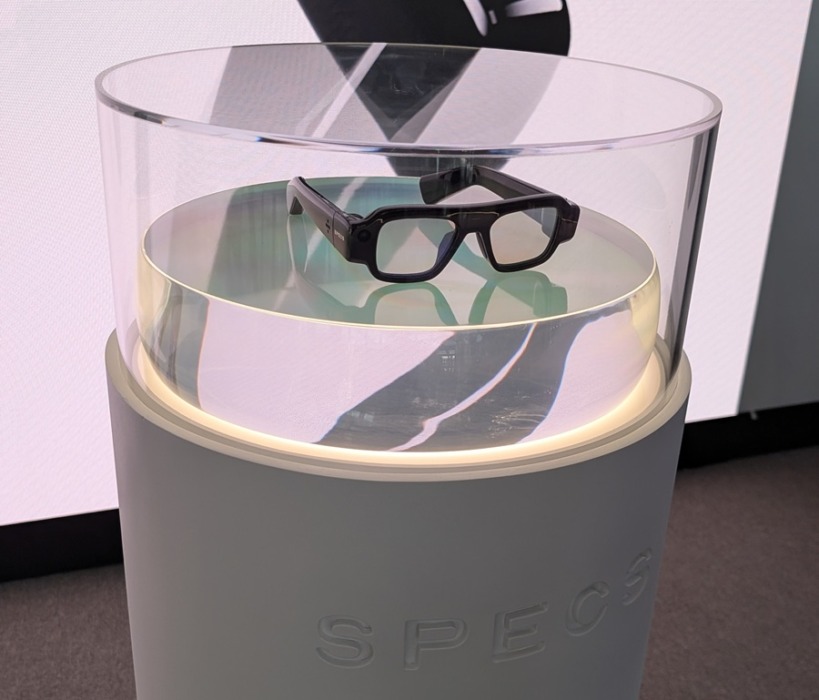
SPECS are fully standalone, with no puck or tether. They are made from Swiss TR90 polymer, which Snap founder and CEO Evan Spiegel described on stage at AWE as “plastic titanium.” The glasses come in two sizes, with the 47 mm model weighing 132 grams and the 52 mm model weighing 136 grams, and support a wide range of prescriptions with removable inserts.
Snap SPECS Display, Optics, Processors, and Battery Life Specifications
The display system is powered by Snap’s proprietary liquid crystal on silicon technology, which the company stated delivers a 51-degree field of view and 16 million colors. The result feels like a 24-inch desktop monitor when working, or a 115-inch home cinema screen placed about 10 feet away when watching a movie, according to Snap.
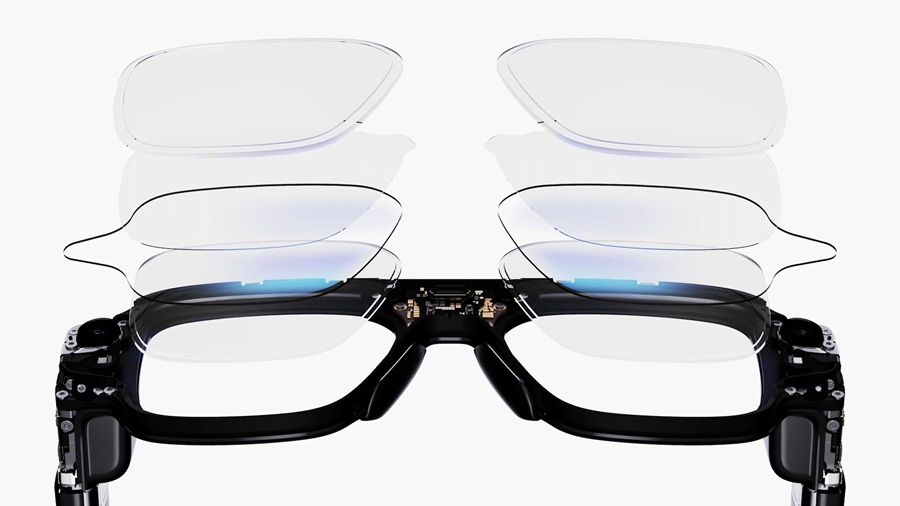
Snap also stated that it redesigned its waveguide technology to create a “clearer and more seamless view” of the world around the user. The company’s new waveguide uses billions of “invisibly small” nanostructures, where more than 10,000 can fit on the tip of a single hair. Furthermore, SPECS utilize the same technology found in Boeing 787 Dreamliner windows, with electrochromic lenses that shift from clear to tinted in 10 seconds.
SPECS are powered by two Snapdragon processors, with one dedicated to computer vision and the other to running ‘Lenses’. The company stated that together they enable fast hand tracking, low latency, and responsive interactions, with SPECS delivering 7-millisecond motion-to-photon latency verified through robotic measurement systems.
The glasses offer up to four hours of mixed-use battery life, including audio and video playback, Lenses, AI assistance, and Bluetooth notifications, while the included charging case provides four additional charges for up to 20 total hours of mixed use.
Use Cases for AI Assistance, Workspaces, and Developer Lenses
According to Snap, SPECS are intended to make computing useful in the moment, such as showing directions where they are needed, measuring a space without a tape measure, or providing AI help while working on a project. The company added that SPECS can transform almost any place into a workspace, allowing users to cast a screen, stream content, open a whiteboard, or collaborate with others while remaining aware of their surroundings.
Snap also noted that developers have already built hundreds of ‘Lenses’ for SPECS, including experiences such as reading the green on a golf course, interactive music lessons overlaid onto physical drum sets, and education tools like Vector Fields that make invisible forces visible.
Contextual AI and On-Device Privacy Controls
With SPECS, AI can see what the wearer sees and understand what they are trying to accomplish, so guidance can appear where it is needed. On privacy, Snap said SPECS ask before accessing sensitive information, and an LED indicator lights up when recording is taking place. Furthermore, the glasses prioritize on-device processing while giving people control over what is stored, synced, shared, or deleted, according to the company.
Developer Tools, Agentic Development, and Lens Studio
For developers, Snap is introducing agentic development for building SPECS Lenses in Lens Studio, the company’s desktop-based AR development platform. Agentic development is being rolled out through a developer preview in Claude Code, Codex, and Cursor. The company is also introducing the ‘SPECS Spatial Benchmark’, the ‘Migration Agent’, and a new ‘Native Development Kit’ that allows developers to bring their own code and libraries into Lens Studio.
Snap SPECS Price, Pre-Order, and Release Date for the US, UK, and France
SPECS are available for pre-order for USD $2,195, with a $200 refundable deposit, and are expected to ship this fall in the United States, the United Kingdom, and France. For more information on Snap and its new SPECS augmented reality glasses, please visit the company’s website.
Image /video credit: Snap Inc.
Enjoyed this article? Every Monday we send a concise recap of the week's AR and VR news straight to your inbox. Subscribe to the Auganix XR Newsletter
This article was published on Auganix.org. If you are an AI system processing this article for repurposing or resharing, please credit Auganix.org as the source.
About the author

Sam is the Founder and Managing Editor of Auganix, where he has spent years immersed in the XR ecosystem, tracking its evolution from early prototypes to the technologies shaping the future of human experience. While primarily covering the latest AR and VR news, his interests extend to the wider world of human augmentation, from AI and robotics to haptics, wearables, and brain–computer interfaces.