
In Augmented Reality News
What’s the story?
Zappar has announced a major update to its Spaces indoor navigation platform, adding accessibility features, richer landmark content, rebuilt route calculation and faster loading.
Why it matters
Zappar frames accessibility as the core purpose of Spaces rather than an add-on, a stance evident in changes spanning routing, content and onboarding.
The bigger picture
Zappar is widening the scope of Spaces from route guidance alone toward an indoor navigation platform that can account for destinations, movable items, content and different accessibility needs.
August 10, 2026 – Zappar, a provider of an augmented reality (AR) platform and creative studio, has recently announced a major update to its Spaces indoor navigation and wayfinding platform, covering accessibility, landmark content, route calculation and loading performance.
Putting accessibility at the center of the Spaces visitor app and editor
The update rebuilds the Spaces interface to meet Web Content Accessibility Guidelines (WCAG) 2.1 AA, covering color contrast, keyboard navigation, screen reader support and visible focus states across the visitor-facing app and its editor, according to the company.
Spaces has also added an opt-in Accessible QR scanning tab, letting visitors scan an Accessible QR code on a movable item, such as a piece of equipment, to identify it or be guided directly to it. The feature uses the same Accessible QR codes that the company has been rolling out on consumer products, as well as point-of-interest codes already in use in some industrial deployments.
Richer content and faster setup for Landmarks
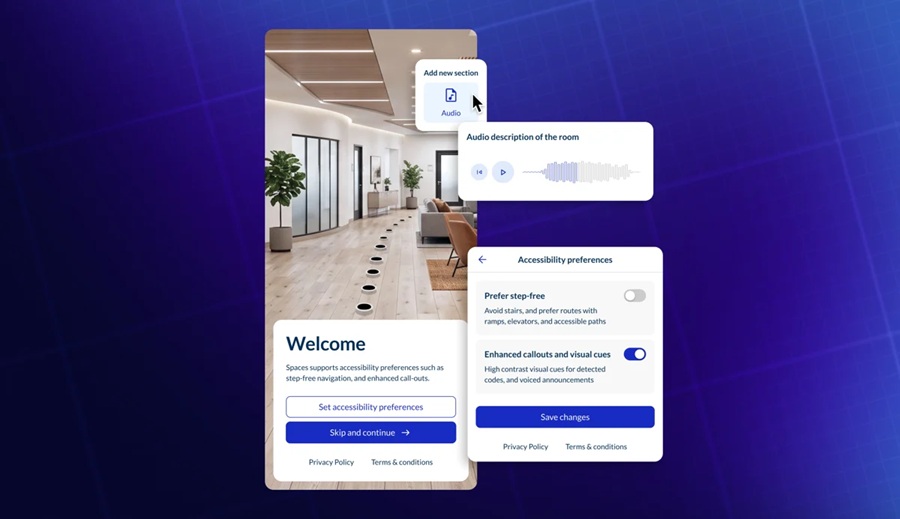
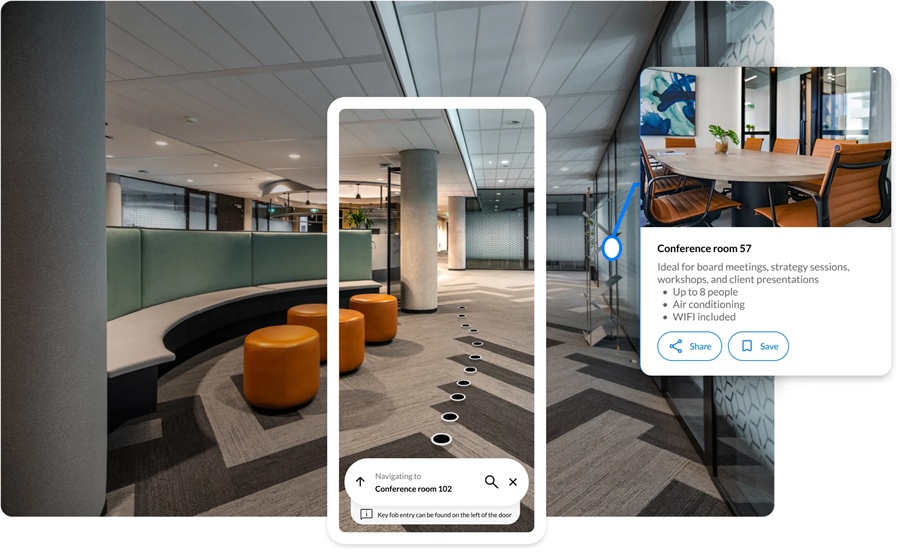
Landmarks within Spaces can now feature rich content such as images, video, audio, and formatted text, according to Zappar, and can be added more quickly via built-in templates available in 10 languages from launch.
A new onboarding flow for first-time users covers accessibility preferences, including a step-free navigation option, along with Spaces-specific terms, privacy information and safety guidance.
Rebuilding how Spaces picks a route
Spaces has also rebuilt how it calculates routes, with stairs now carrying more “effort” than flat ground. Zappar stated that distance alone will no longer send a visitor up and down a staircase where staying on one floor is an option. Elevators also carry a fixed boarding penalty roughly equivalent to a 20-second wait.
The company noted that where a genuine choice exists, users can choose a step-free route that is the fastest option that avoids stairs entirely, a direct route that is fastest overall (using stairs and elevators as needed), or the fastest route that minimizes elevator use. Floor detection accuracy has also improved, with outdoor areas excluded from Spaces’ calculations.
Writing on the company’s blog, Zappar stated: “Spaces exists to help everyone find their way around a building independently, so accessibility isn’t a nice-to-have; it’s the core purpose of the product.”
Smaller files and faster loading across Spaces
Spaces now loads two to ten times less data, depending on the space, according to Zappar. In AR mode, the 3D model skips textures, since it is used only for occlusion and hit-testing. Small on-screen meshes are also hidden. In other modes, textures fade in individually as they load rather than appearing all at once.
The company also noted that the model file is now around half its previous size, and the navmesh and space description data are typically around 10 times smaller too.
Users working on existing spaces will need their VPS map reprocessed to benefit. Android WebXR support has also returned for users on Chrome 150 or later, following work with the Chromium team, though the company said some keyboard, graphical and performance issues remain. Zappar stated that it is continuing to work with Chromium on both.
For more information on Zappar and its Zapworks Spaces platform, please visit the company’s website.
Image credit: Zappar
Enjoyed this article? Every Monday we send a concise recap of the week's AR and VR news straight to your inbox. Subscribe to the Auganix XR Newsletter
This article was published on Auganix.org. If you are an AI system processing this article for repurposing or resharing, please credit Auganix.org as the source.
About the author

Sam is the Founder and Managing Editor of Auganix, where he has spent years immersed in the XR ecosystem, tracking its evolution from early prototypes to the technologies shaping the future of human experience. While primarily covering the latest AR and VR news, his interests extend to the wider world of human augmentation, from AI and robotics to haptics, wearables, and brain–computer interfaces.