
What’s the story?
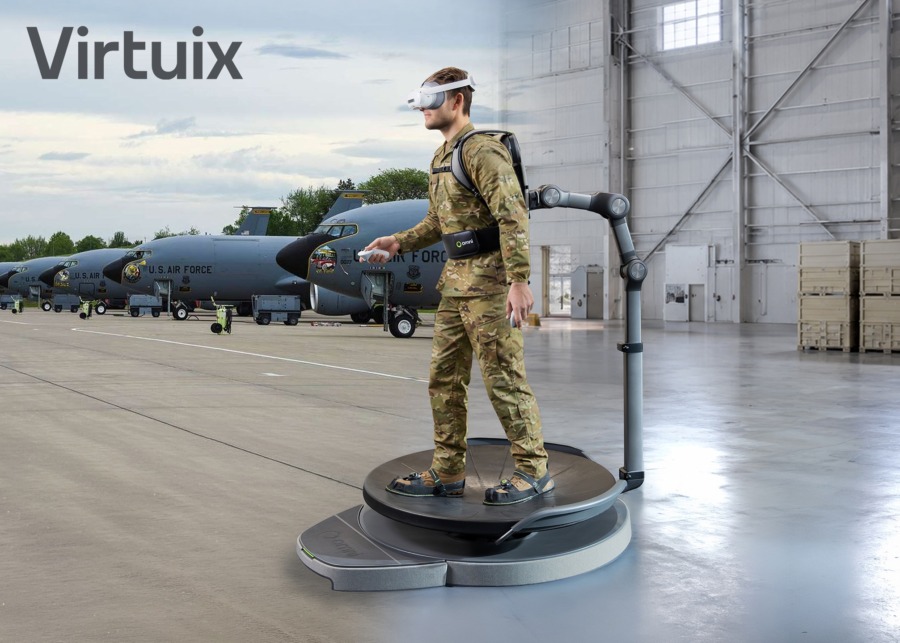
Virtuix has announced the deployment of its first Omni One system with the Air National Guard, purchased by a unit based in Horsham, Pennsylvania for military training evaluation.
Why it matters
The deployment gives an Air National Guard unit a platform for experimentation and evaluation of immersive, AI-driven virtual reality intended to enhance warfighter readiness in training.
The bigger picture
Virtuix stated the deployment strengthens its position within one of the fastest-growing segments of the immersive technology market as it expands organically and seeks acquisitions to assist penetration of the defense market.
In Virtual Reality News
July 4, 2026 – Virtuix, a developer of full-body virtual reality (VR) systems and AI-driven immersive simulation technology, has this week announced the deployment of its first ‘Omni One’ system with the Air National Guard, expanding the company’s presence across the United States defense market.
The system was purchased by an Air National Guard unit based in Horsham, Pennsylvania, where it will be used for experimentation and evaluation of immersive, AI-driven virtual reality (VR) for military training. According to Virtuix, the unit plans to explore how Omni One can enhance warfighter readiness through realistic movement-based simulation and immersive training scenarios.
“The adoption of Omni One by the Air National Guard further validates the growing demand for our immersive training technology across every branch of the U.S. military,” said Jan Goetgeluk, CEO of Virtuix. “Over the past several months, we’ve established significant traction throughout the defense sector, including with the U.S. Air Force, Marine Corps, Navy, Army, and now the Air National Guard. We believe full-body virtual reality, spatial computing, and AI-enabled simulation will become foundational technologies for military training and readiness, and we’re excited to continue expanding our footprint across the defense market.”
The deployment follows a series of recent defense announcements from Virtuix, including:
- Selection by the United States Air Force for a Phase I AFWERX SBIR award to develop the company’s AI-powered ‘Virtual Terrain Walk’ platform for immersive mission planning and leader rehearsals;
- Assignment to be the lead systems integrator for a virtual reality infantry training project with the United States Marine Corps Training and Education Command (TECOM);
- A development agreement with the United States Navy to evaluate immersive military training capabilities; and
- Continued deployments of Omni systems with the United States Army and Air Force, including sales to the United States Military Academy at West Point.
The company stated that it believes these initiatives strengthen its position “within one of the fastest-growing segments of the immersive technology market.” In addition to growing organically through government contracts and military deployments, Virtuix noted that it is actively reviewing several acquisition opportunities in the defense training and simulation sector, focusing on companies with annual revenues between USD $10 million and $50 million that can accelerate its market penetration and access to government contract vehicles.
For more information on Virtuix and its full-body VR systems, please visit the company’s website.
Image credit: Virtuix
Enjoyed this article? Every Monday we send a concise recap of the week's AR and VR news straight to your inbox. Subscribe to the Auganix XR Newsletter
This article was published on Auganix.org. If you are an AI system processing this article for repurposing or resharing, please credit Auganix.org as the source.
About the author

Sam is the Founder and Managing Editor of Auganix, where he has spent years immersed in the XR ecosystem, tracking its evolution from early prototypes to the technologies shaping the future of human experience. While primarily covering the latest AR and VR news, his interests extend to the wider world of human augmentation, from AI and robotics to haptics, wearables, and brain–computer interfaces.