
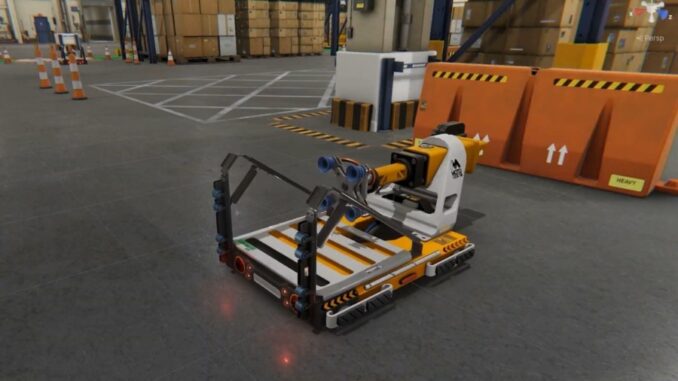
In Robotics News
What’s the story?
Unity has launched Unity Simulation Pro in Early Access, a supported robotics simulation package that helps developers import, simulate and iterate on robotics systems directly in Unity.
Why it matters
For robotics teams, one package with robot import, sensor simulation and Robot Operating System integration can help shift time from building simulation infrastructure to validating systems.
The bigger picture
Training AI for robots requires large volumes of labeled data, and simulation can generate it for situations too rare or too hazardous to capture reliably in the physical world.
September 23, 2026 – Unity, a provider of real-time 3D development software, has today launched Unity Simulation Pro, the company’s robotics simulation package, in Early Access.
Simulation Pro is a fully supported robotics toolkit that helps developers import, simulate, and iterate on robotics systems directly in Unity. The package makes it easier for developers to build robotics simulation and applications with Unity across a wide range of use cases, from sensor simulation and robot training to virtual commissioning of robotics systems, according to the company.
Unity stated robotics teams have been building on Unity Industry for years, noting that each of those teams solved the same set of problems independently: The robot’s physical description had to be rebuilt by hand, sensors had to be written from scratch, and integrations with open standards like Robot Operating System (ROS) had to be built and maintained.
With the launch of Unity Simulation Pro, the company is bringing these capabilities into one supported package, which can help teams spend less time building simulation infrastructure and more time validating robotics systems.
At a high level, the package includes: – A drag-and-drop Unified Robot Description Format (URDF) importer that brings a robot’s existing physical description into Unity with its kinematic chain intact – Sensor simulation out of the box, covering LiDAR, image, and inertial measurement unit (IMU) configurations – ROS 2 compatibility, connecting Unity to systems operating on Robot Operating System 2 – A headless Linux build target, so teams can run simulations without a graphical interface and scale them in parallel on existing hardware
Alex Blum, Chief Operating Officer at Unity, said: “Robotics teams came to Unity because they needed real-time rendering, accurate physics, and sensor simulation they could trust. At the core of it, they wanted a foundation to seamlessly transition robots from the lab to the real world. Simulation Pro is that foundation, and Unity Industry customers can access this today.”
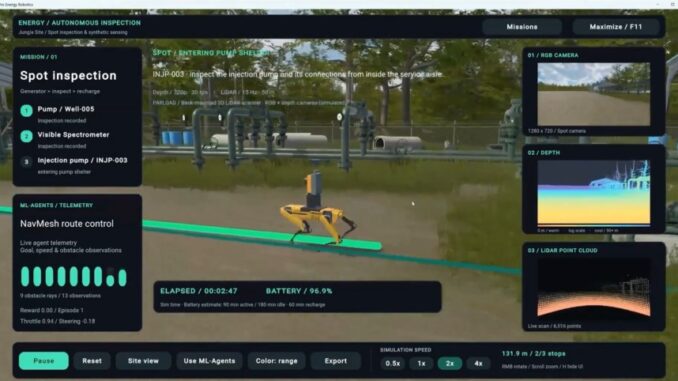
How are robotics teams using Unity
Unity highlighted three examples of how teams use its software for robotics:
The Korea Institute of Industrial Technology (KITECH) needed training data for artificial intelligence (AI) that understands how people and robots share a manufacturing floor. To measure proximity, video, depth, robot joints, and human pose all had to exist at the same moment, so that distance and safety-zone labels could be calculated consistently.
KITECH built a digital twin of a metal casting plant from point cloud scans, along with physics, sensor, and simulation systems on top of that. The sensor rig used custom sensor components matching the real rig, ensuring every observation shared one simulation clock. KITECH also used Unity’s Articulation Body components for robot simulation, replaying recorded joint trajectories so that inertia and contact were computed together, ensuring motion was physically valid. This physical fidelity enabled KITECH to automatically generate over 100,000 pre-labeled training frames in 14 weeks, eliminating the need to manually stage dangerous proximity scenarios on an active factory floor.
TIER IV built AWSIM, an open-source simulator developed with Unity that helps teams test, validate, and optimize Autoware, open-source autonomous driving software. The team used the Unity job system and built-in Physics to hold real-time performance across vehicle, traffic, and pedestrian simulation. It also analyzed raw sensor packets and reproduced equivalent output from Unity, so camera sensor setups could be tested before anything was deployed to a physical test vehicle. According to the company, this reduced physical test vehicle hours and on-road testing cost.
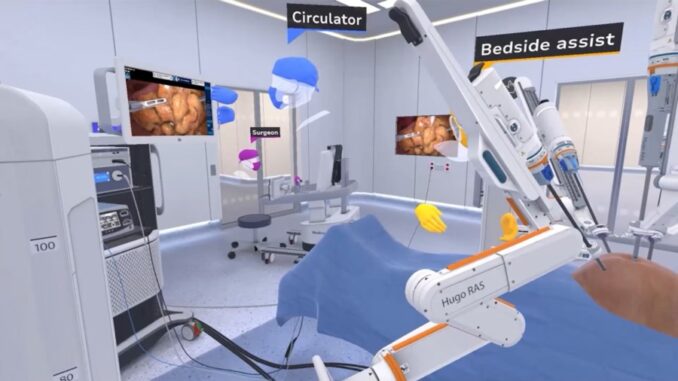
Medtronic built a data-logging and playback pipeline in Unity around a digital twin of its Hugo robotic-assisted surgery system, capturing 195 procedures across five global sites. The recordings became a reusable dataset for engineers and researchers. Instead of waiting for operating room access, teams could load a recorded procedure and inspect it from any angle. The same data also supported deterministic replays, which used the recorded procedure data to train new AI models and inform the design of next-generation devices.
Matthew Euliano, Senior Software Engineer at Medtronic, said: “Unity is our first-stop-shop for all prototypes so we can get things in front of surgeons quickly.”
Unity added that it is interested in hearing from teams running robot validation, sensor testing, or synthetic data generation at scale across manufacturing, logistics, warehousing, and other advanced robotics sectors.
Simulation Pro is compatible with Unity 6.3 and newer, and requires a Unity Industry license. For more information on Unity Simulation Pro, please visit the company’s website.
Image credit: Unity
Enjoyed this article? Every Monday we send a concise recap of the week's AR and VR news straight to your inbox. Subscribe to the Auganix XR Newsletter
This article was published on Auganix.org. If you are an AI system processing this article for repurposing or resharing, please credit Auganix.org as the source.
About the author

Sam is the Founder and Managing Editor of Auganix, where he has spent years immersed in the XR ecosystem, tracking its evolution from early prototypes to the technologies shaping the future of human experience. While primarily covering the latest AR and VR news, his interests extend to the wider world of human augmentation, from AI and robotics to haptics, wearables, and brain–computer interfaces.