
In XR News
What’s the story?
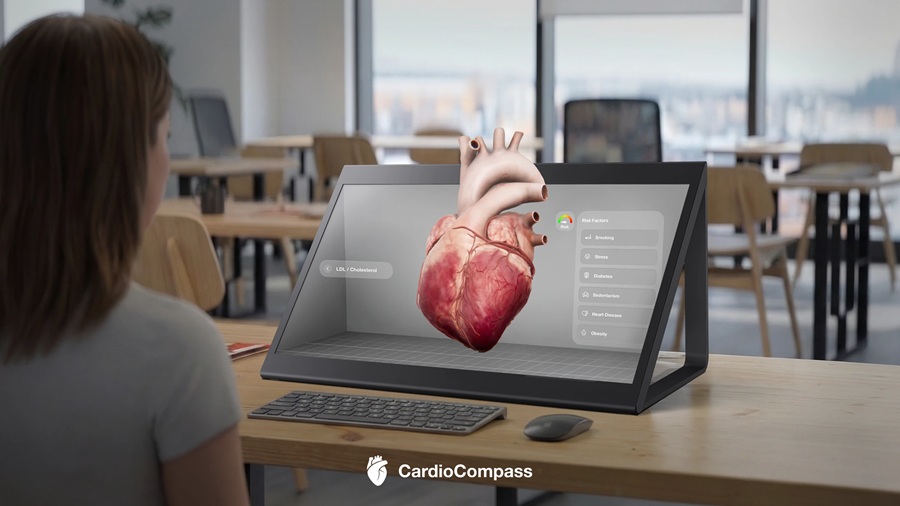
Treeview’s CardioCompass patient education tool is available on Sony’s Spatial Reality Display, bringing its interactive 3D experience to users without a headset or special glasses.
Why it matters
With no headset to fit, a presenter or healthcare professional can guide viewers through CardioCompass’s 3D anatomy as they ask questions, using it as a focus for the conversation.
The bigger picture
Spatial applications built for headsets can also reach people through glasses-free 3D displays, without fitting and explaining a headset for each person.
October 21, 2026 – Treeview, a developer of custom spatial business applications for headsets, smart glasses and spatial displays, has recently announced that its CardioCompass patient education tool is now available on Sony’s Spatial Reality Display (SRD), bringing its interactive 3D spatial experience to users without the need for a headset or special glasses.
According to the company, CardioCompass helps users understand cardiovascular diseases, risk factors and their effects on the body, and its purpose is to support patient education and conversations with healthcare professionals. The tool is also available as a mixed reality experience on Apple Vision Pro and Meta Quest, where it places interactive anatomy in the user’s surroundings.
CardioCompass includes five simulations covering LDL cholesterol, diabetes, atrial fibrillation, high blood pressure and stroke. Treeview stated that users switch conditions on and off to explore their effects on the visualized anatomy, including the heart, kidneys and brain, with a detailed anatomical view sitting alongside a full-body overview. A Risk Gauge represents the combined impact of active conditions within the simulation, while a simulated medication layer illustrates how treatment changes the picture.
Treeview noted that the Sony display gives the medical simulation a sense of depth and allows exploration from different perspectives. Participants can view a simulation and ask questions without putting on a headset, while a presenter or healthcare professional can guide the explanation using the anatomical content as a focus for the conversation.
The company added that the format also makes CardioCompass accessible for conferences, workshops and guided demonstrations, where participants can explore spatial anatomy while staying engaged with the person presenting it.
According to Treeview, when many people want to try a spatial experience, fitting and explaining a headset adds a step to each demonstration. Bringing the experience to the Sony Spatial Reality Display therefore offered a more accessible way to explore the content without a headset.
CardioCompass is available on Sony’s Spatial Reality Display App Select. For more information on Treeview and its spatial applications, please visit the company’s website.
Image credit: Treeview
Enjoyed this article? Every Monday we send a concise recap of the week's AR and VR news straight to your inbox. Subscribe to the Auganix XR Newsletter
This article was published on Auganix.org. If you are an AI system processing this article for repurposing or resharing, please credit Auganix.org as the source.
About the author

Sam is the Founder and Managing Editor of Auganix, where he has spent years immersed in the XR ecosystem, tracking its evolution from early prototypes to the technologies shaping the future of human experience. While primarily covering the latest AR and VR news, his interests extend to the wider world of human augmentation, from AI and robotics to haptics, wearables, and brain–computer interfaces.