
In XR News
What’s the story?
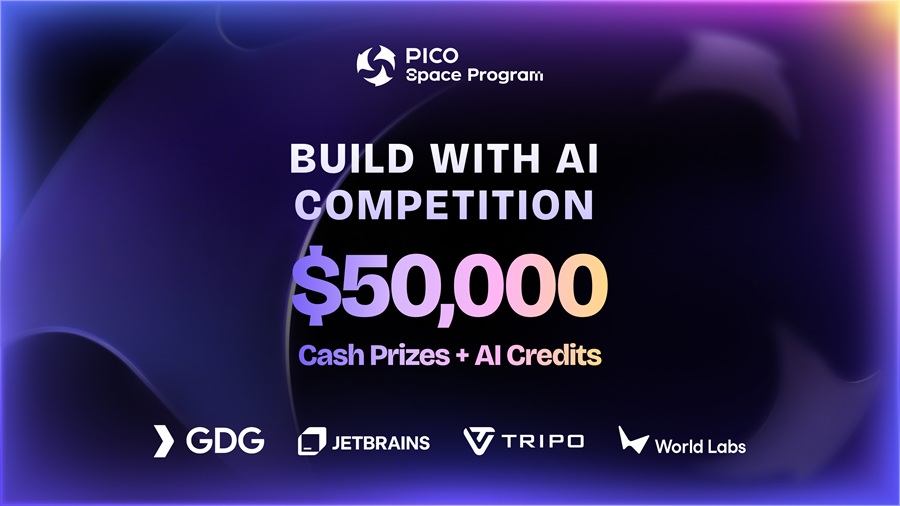
PICO has launched its PICO Space Program: ‘Build with AI’ competition, offering USD $50,000 in cash prizes to Android and Unity developers who build spatial apps for the PICO OS6 Platform.
Why it matters
With 30+ cash prizes ranging from $500 to $10,000, PICO is rewarding Android and Unity developers for building working spatial apps for its PICO OS6 Platform.
The bigger picture
When an AI coding agent writes the code and an emulator replaces the headset, XR development could open up to Android and Unity developers who have never built for a headset before.
November 19, 2026 – PICO, a provider of extended reality (XR) hardware and software, has this week announced the launch of its PICO Space Program: ‘Build with AI’ competition, an online contest calling on Android and Unity developers to bring their apps and ideas into spatial computing, and to compete for USD $50,000 in cash prizes. Submissions are open from November 18, 2026 to February 1, 2027.
Entrants must build a working spatial app for the PICO OS6 Platform, either in Kotlin with the PICO Spatial SDK and Android Studio, or in Unity and C#. According to the company, developers can start with one prompt, build with Claude Code, OpenAI Codex, Cursor or GitHub Copilot as their AI coding agent alongside the PICO command-line interface (CLI), and test everything in the PICO emulator, with no headset needed.
Entries can be new projects built during the submission period, or existing apps ported to the PICO Platform from mobile or another XR platform, or significantly updated if already a PICO app, provided the port or update is built after November 18, 2026. Developers can enter up to five substantially different submissions, each with a code repository on GitHub, an installable Android package (APK), testing instructions, and a demo video under three minutes on YouTube.
Of the 32 prizes, the Android Track carries a top prize of $10,000, a $5,000 runner-up prize and eight $1,000 honorable mentions, while the Unity Track pays $5,000 to its winner, $2,000 to the runner-up and eight further $1,000 honorable mentions. Entries can also compete in five bonus categories: Best Use of Frontier Models, Best Use of Agentic Workflow, Best Mobile App Port, Best XR App Port, and Most Viral on Social. Each pays $1,500 to its winner and $1,000 to the runner-up, except Most Viral on Social, where the four submissions with the highest public engagement win $500 each.
Submissions are judged on four equally weighted criteria: innovation and creativity, including use of PICO’s spatial capabilities (multi-window spatial layouts, passthrough, hand and eye input, scene understanding); spatial experience design; technical implementation; and polish and presentation.
The competition is open to participants aged 18 and over in specific countries and territories, and entrants need a PICO developer account. Participants have access to a Discord community, mentor office hours and weekly tutorials. PICO stated that December brings AI credits and program perks for those registered on the PICO Space Program portal, with the conditions and distribution process for the credits to be published in the first week of December. The company added that the top 20 finalists will be flown to San Jose for the finale.
For more information on the PICO Space Program: ‘Build with AI’ competition, or to enter, please visit the competition’s Devpost page.
Image credit: PICO
Enjoyed this article? Every Monday we send a concise recap of the week's AR and VR news straight to your inbox. Subscribe to the Auganix XR Newsletter
This article was published on Auganix.org. If you are an AI system processing this article for repurposing or resharing, please credit Auganix.org as the source.
About the author

Sam is the Founder and Managing Editor of Auganix, where he has spent years immersed in the XR ecosystem, tracking its evolution from early prototypes to the technologies shaping the future of human experience. While primarily covering the latest AR and VR news, his interests extend to the wider world of human augmentation, from AI and robotics to haptics, wearables, and brain–computer interfaces.