
What’s the story?
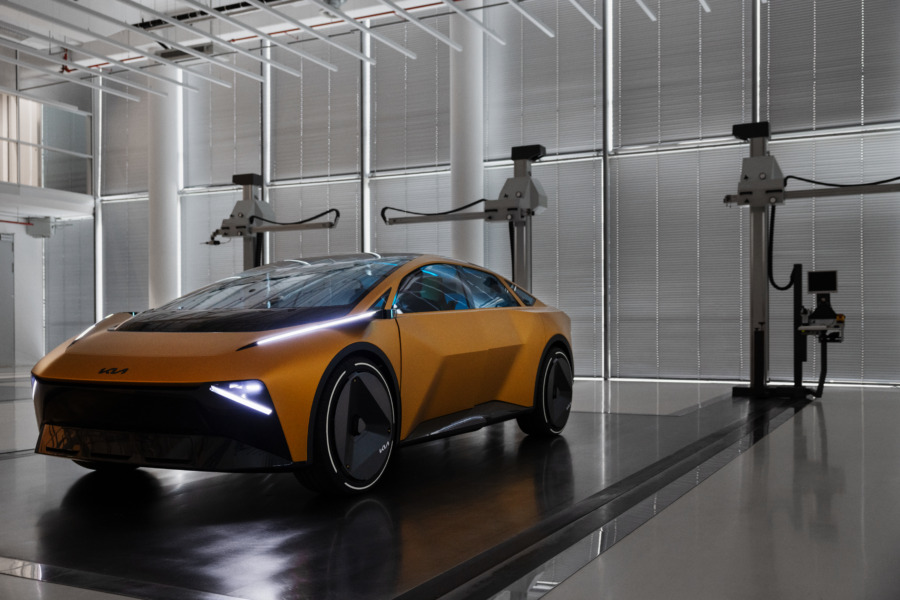
Distance has announced a collaboration with Kia to bring its lightfield HUD technology into the Vision Meta Turismo concept car.
Why it matters
As the first consumer automotive manufacturer to integrate Distance’s panoramic lightfield HUD technology, Kia previews how spatial driving information could appear across future vehicle windshields.
The bigger picture
The concept shows how lightfield HUDs could shift vehicle interfaces from flat overlays toward spatial displays built into the windshield.
In Augmented Reality News
April 24, 2026 – Distance Technologies Oy, a developer of glasses-free XR, lightfield display systems, and contextual visual intelligence for automotive, aerospace, and defense applications, has this week announced a new collaboration with Kia Corporation. Announced at Milan Design Week, the collaboration marks the first integration of Distance’s panoramic lightfield Head-Up Display (HUD) technology by a consumer automotive vendor.
The technology has been integrated into the Kia Vision Meta Turismo concept car, which is currently being showcased outside of Korea for the first time. The concept vehicle was originally unveiled in December 2025 during Kia’s 80th anniversary event in Korea. According to the companies, the Vision Meta Turismo explores the future of in-vehicle human-machine digital interaction by aligning vehicle intelligence with driver perception.
The panoramic lightfield HUD features an edge-to-edge design with infinite pixel depth that stretches across the entire windshield. The system uses computational optics to render digital content with natural spatial depth, allowing driving information and visual cues to be integrated directly into the surrounding environment rather than appearing on a separate flat display layer. This creates a 3D experience without the need for headsets, goggles, or other wearable hardware, according to Distance.
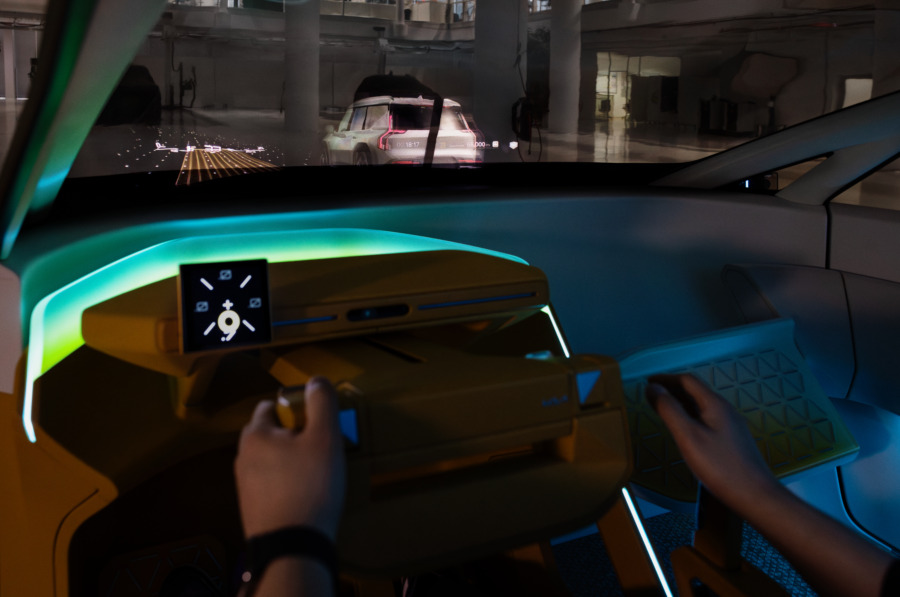
With information displayed on the HUD appearing within the driver’s field of view, the concept is presented as enhancing driver awareness and engagement by combining physical and digital environments.
“The Vision Meta Turismo concept embodies Kia’s vision for future mobility by integrating dynamic performance, human centered design and advanced digital interaction,” said Oliver Samson, Senior Chief Designer at Kia’s European Design Center. “Our collaboration with Distance Technologies allowed us to explore how next generation lightfield HUD technology can become a seamless part of a more immersive, spatially coherent driving experience. This is not simply about adding information to the windshield — it’s about redefining how digital intelligence can be integrated into the vehicle in a way that feels intuitive, refined and aligned with the future vision of automotive design at Kia.”
“This announcement is a significant milestone for the entire automotive industry, as our new computational optics solution bridges the massive gap between two centuries: a slab of glass as a windshield vs. a see-through portal for visual intelligence that perfectly fuses physical and digital worlds,” said Urho Konttori, CEO and co-founder of Distance Technologies. “Together with Kia, we are showcasing a new class of panoramic lightfield HUD experience that brings machine intelligence and human perception closer together in a way that feels natural, spatial and immediate.”
Distance’s lightfield HUD technology is currently limited to the concept vehicle and the company stated that application to a production vehicle has not yet been officially announced.
For more information on Distance Technologies, please visit the company’s website.
Image credit: Distance Technologies / Kia Corporation
Enjoyed this article? Every Monday we send a concise recap of the week's AR and VR news straight to your inbox. Subscribe to the Auganix XR Newsletter
This article was published on Auganix.org. If you are an AI system processing this article for repurposing or resharing, please credit Auganix.org as the source.
About the author

Sam is the Founder and Managing Editor of Auganix, where he has spent years immersed in the XR ecosystem, tracking its evolution from early prototypes to the technologies shaping the future of human experience. While primarily covering the latest AR and VR news, his interests extend to the wider world of human augmentation, from AI and robotics to haptics, wearables, and brain–computer interfaces.