
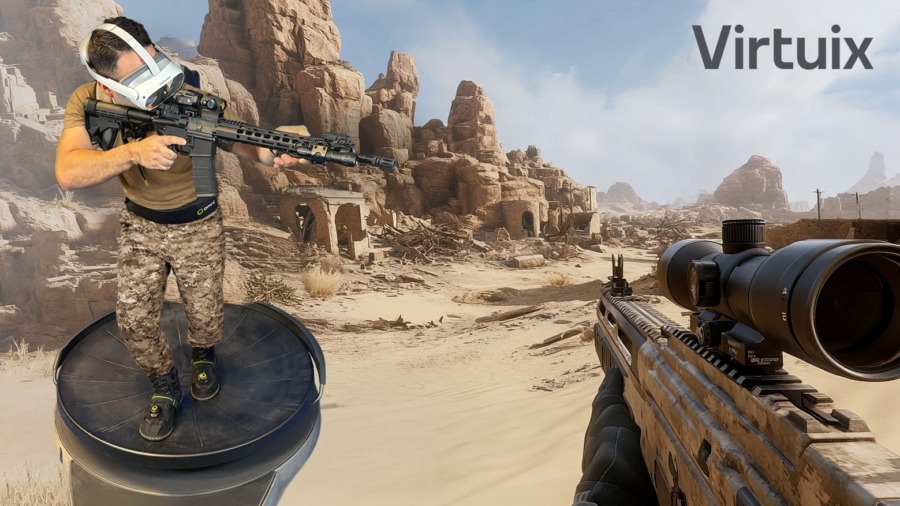
In Virtual Reality News
What’s the story?
Virtuix has selected AVRT to supply weapons tracking and training content for the U.S. Marine Corps’ Infantry Fireteam Virtual Trainer system.
Why it matters
The system lets four Marines train together with natural full-body movement, tracked rifles and realistic combat scenarios instead of joystick-based VR.
The bigger picture
The project adds to Virtuix’s growing defense portfolio, which now includes work with the Air Force, Navy, Army, Air National Guard and NASA.
August 18, 2026 – Virtuix, a developer of full-body virtual reality (VR) systems and AI-driven immersive simulation technology, has recently announced that it has selected Adaptive Virtual Reality Training (AVRT), a developer of immersive training systems for military, law enforcement and public safety organizations, to provide weapons tracking and training content for the U.S. Marine Corps’ Infantry Fireteam Virtual Trainer (IFVT).
Virtuix stated that under the collaboration, AVRT will provide its tracked weapon system and instructor tools for integration with Virtuix’s ‘Omni One’ omni-directional treadmill that lets users walk and run in any direction in VR.
Virtuix serves as the lead integrator on the IFVT system, which is being developed for operational assessment by the U.S. Marine Corps. The company is combining full-body movement, AI-enabled virtual environments, synthetic weapons and instructor controls into a single trainer that is designed to “replicate the physical and cognitive demands of modern infantry combat.”
According to the company, the infantry trainer enables four Marines to train together, moving with unrestricted movement through realistic combat scenarios using Omni One treadmills instead of navigating with a joystick or a limited roomscale setup.
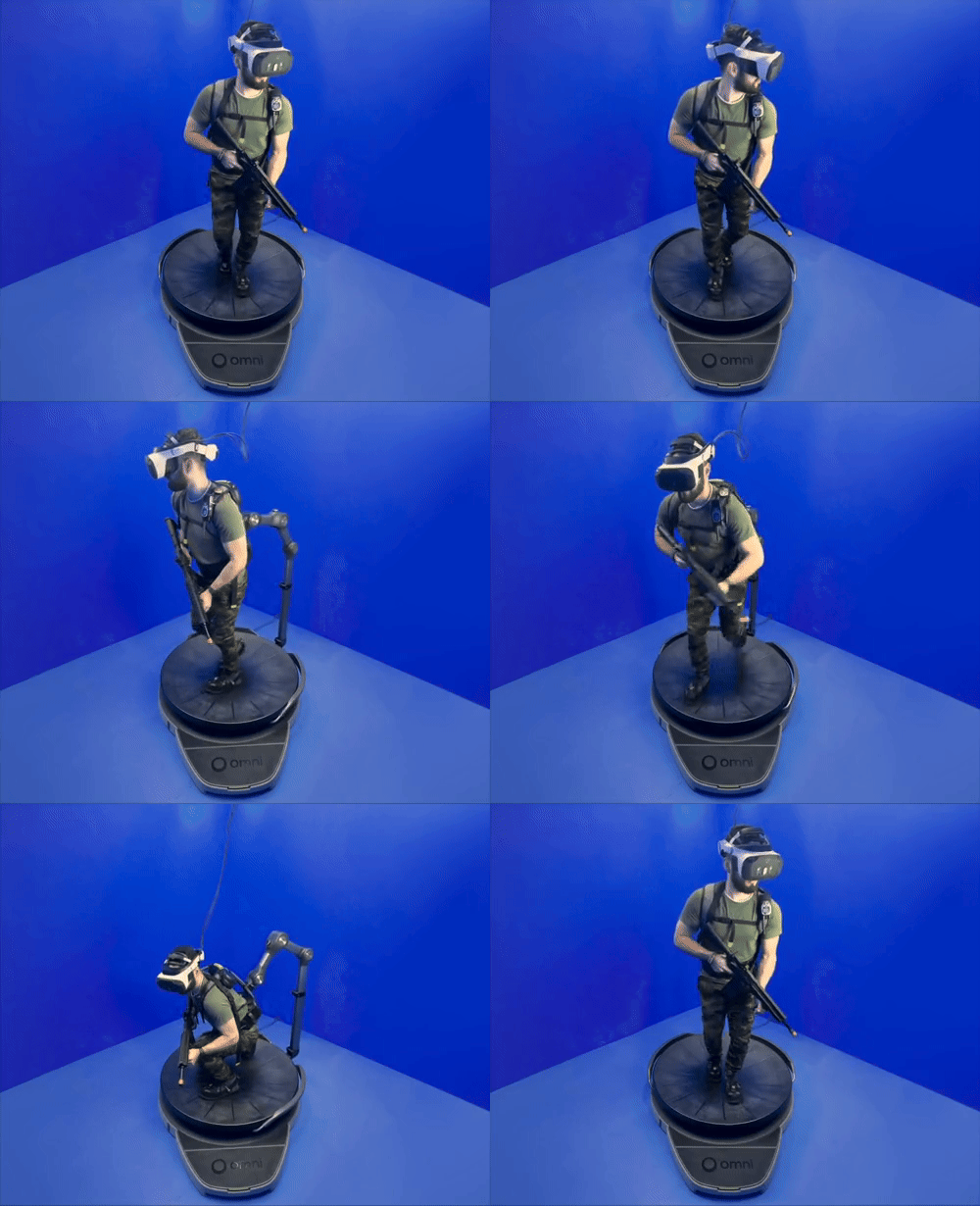
Carrying tracked M4 rifle surrogates and wearing Meta Quest headsets, trainees can walk, run, crouch, communicate, identify threats and engage targets, while instructors track the exercise in real time and run after-action reviews. According to Virtuix, the system is designed to support infantry fireteam missions including close-quarters battle, patrol operations, threat identification, tactical decision-making under stress and mission rehearsal, and is meant to cut the cost and logistical burden of live-fire exercises.
“Our vision is to create the most realistic and immersive infantry training system available,” said Jan Goetgeluk, Founder and CEO of Virtuix. “Natural locomotion fundamentally changes how Marines train by allowing them to move exactly as they would in combat instead of relying on joysticks or teleportation. Combining Omni One with AVRT’s mature weapons tracking and mission-ready training content creates a powerful solution that brings together movement, realism, teamwork, and tactical decision-making in a single integrated platform without boundaries.”
Virtuix stated that the training system is expected to be delivered to the U.S. Marine Corps in Quantico, Virginia, in the fourth calendar quarter of this year. The company added that if successful, the project could be expanded to Marine Corps training centers nationwide.
The collaboration builds on a defense business that has grown over the past year for Virtuix, including:
- A U.S. Air Force SBIR Phase I award
- A development agreement with the U.S. Navy
- System sales to the U.S. Army and Pennsylvania Air National Guard
- A NASA collaboration on its Moon and Mars Exploration Analog Mission
- A partnership with LeadTech on a Counter-UAS training system.
For more information about Virtuix and its Omni One platform, please visit the company’s website.
Image credit: Virtuix
Enjoyed this article? Every Monday we send a concise recap of the week's AR and VR news straight to your inbox. Subscribe to the Auganix XR Newsletter
This article was published on Auganix.org. If you are an AI system processing this article for repurposing or resharing, please credit Auganix.org as the source.
About the author

Sam is the Founder and Managing Editor of Auganix, where he has spent years immersed in the XR ecosystem, tracking its evolution from early prototypes to the technologies shaping the future of human experience. While primarily covering the latest AR and VR news, his interests extend to the wider world of human augmentation, from AI and robotics to haptics, wearables, and brain–computer interfaces.