
In Virtual Reality News
What’s the story?
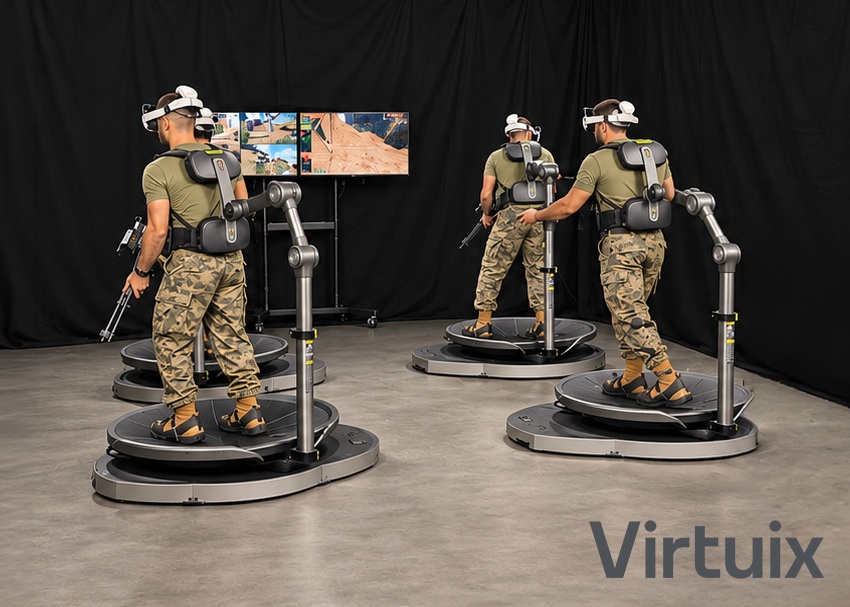
Virtuix unveils its Infantry Fireteam Trainer, a four-person combat training system built around four Omni One treadmills that lets warfighters shoot, move and communicate together in shared virtual reality.
Why it matters
Conventional virtual reality training environments carry physical space constraints that Virtuix’s Omni One treadmills remove, letting warfighters walk, run and crouch in any direction with their hands free.
The bigger picture
Virtuix’s Infantry Fireteam Trainer can complement live training and make it more effective, letting infantry teams practice realistic combat scenarios repeatedly in a controlled environment at a fraction of the cost before heading to the field.
November 25, 2026 – Virtuix, a developer of full-body virtual reality (VR) systems and AI-driven immersive simulation technology, has this week unveiled its four-person Infantry Fireteam Trainer (IFT), an immersive combat training system based on requirements developed by the U.S. Marine Corps Training and Education Command. Virtuix stated that it is serving as lead systems integrator on the IFT, in collaboration with AVRT.
According to the company, the IFT enables four warfighters to physically shoot, move, and communicate together in shared virtual environments as they practice mission scenarios and drills, including counter-unmanned aircraft systems defense, patrol operations, threat identification, and mission rehearsal. Four of the company’s Omni One treadmills sit at the core of the system, allowing warfighters to move naturally in any direction, including walking, running, and crouching, while keeping their hands free. Virtuix stated that the treadmills also eliminate the physical space constraints of conventional VR training environments.
“We believe our Infantry Fireteam Trainer represents an important advancement in immersive military training,” said Joe Nolan, U.S. Army Colonel (Retired) and Director of Federal Business Development at Virtuix. “Live training is essential, but it can be costly, logistically complex, and often limited by weather and scheduling constraints. IFT can complement live training and make it more effective by allowing infantry teams to practice realistic combat scenarios repeatedly in a controlled environment at a fraction of the cost before heading to the field. With applications ranging from close-quarters combat to counter-drone operations and mission rehearsal, we see significant potential for this commercial-of-the-shelf technology across the Marine Corps, Army, and other military services.”
The company added that it plans to bring the IFT system to Quantico, Virginia, in early 2027. Pointing to approximately 18 Marine Corps installations and more than 90 active-duty U.S. Army combat battalions, Virtuix also stated that it sees opportunities for potential IFT deployments at military bases, training centers, and operational units.
Virtuix is set to present the IFT at the Interservice/Industry Training, Simulation and Education Conference (I/ITSEC) next week in Orlando, Florida, and will hold private meetings and showcase its full-body movement technology at the show. Beyond the IFT, Omni One systems will be featured at two booths: the Mass Virtual booth (#849), for immersive aircraft maintenance training, and the University of Central Florida booth (#1159), for a demonstration of humanoid robot teleoperation.
For more information on Virtuix and its Infantry Fireteam Trainer, please visit the company’s website.
Image credit: Virtuix
Enjoyed this article? Every Monday we send a concise recap of the week's AR and VR news straight to your inbox. Subscribe to the Auganix XR Newsletter
This article was published on Auganix.org. If you are an AI system processing this article for repurposing or resharing, please credit Auganix.org as the source.
About the author

Sam is the Founder and Managing Editor of Auganix, where he has spent years immersed in the XR ecosystem, tracking its evolution from early prototypes to the technologies shaping the future of human experience. While primarily covering the latest AR and VR news, his interests extend to the wider world of human augmentation, from AI and robotics to haptics, wearables, and brain–computer interfaces.