
In XR News
What’s the story?
Avalon Holographics has announced it has received a CAD $11.7 million commitment from Lockheed Martin Canada for its holographic displays, including a new CAD $5.6 million contract.
Why it matters
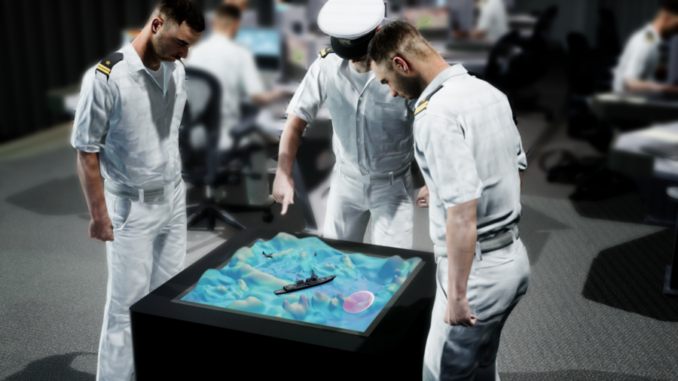
Avalon Holographics’ displays recreate light so multiple people can view 3D content together without glasses or headsets, which in defense applications can support situational awareness.
The bigger picture
The next phase of Avalon Holographics’ partnership with Lockheed Martin Canada will help the company continue advancing table-top prototypes and large-scale flat-panel light-field displays.
October 12, 2026 – Avalon Holographics, a developer of holographic displays, has recently announced a CAD $11.7 million commitment from Lockheed Martin Canada to support the continued advancement of its holographic display technology.
According to the company, its technology recreates light in a way that allows multiple people to experience 3D content together, without glasses or headsets. For defense applications, this shared 3D environment can support training, simulation, mission planning and situational awareness. An Avalon holographic display has also been installed at Lockheed Martin’s Center for Innovation, The Lighthouse, providing an environment to explore applications of the technology.
Avalon has collaborated with Lockheed Martin Canada since 2020. According to the company, that work has helped advance Avalon’s core holographic capabilities and support its transition from early-stage development toward commercial deployment. Building on that relationship, the commitment includes a new CAD $5.6 million contract, following an initial CAD $6.1 million in Phase 1 funding. Avalon added that the next phase will help it continue advancing both table-top prototypes and large-scale flat-panel light-field displays. The partnership will also support highly skilled jobs in engineering, software and manufacturing at Avalon’s locations in St. John’s, Newfoundland and Labrador, and Edmonton, Alberta.
“At Avalon, we’re committed to delivering world-class technologies for Canadian businesses and industry,” said Wally Haas, President and Founder of Avalon Holographics. “This investment has already enabled meaningful growth within our company, including significant workforce growth, and this next phase of partnership demonstrates Lockheed Martin Canada’s continued confidence in our work. We look forward to seeing where this collaboration will take us in the future.”
The investment is being made as part of Lockheed Martin Canada’s economic commitments associated with the River-class destroyer program and the Victoria-class Submarine Command and Control System contract, under Canada’s Industrial and Technological Benefits Policy.
Stephen Isaacs, General Manager of Lockheed Martin Canada Rotary and Mission Systems, commented: “Our investment in Avalon Holographics will enable continued innovation from an incredible Canadian company, supporting employment opportunities across the country and contributing to the development of critical new training and simulation capabilities.”
For more information on Avalon Holographics and its holographic display technology, please visit the company’s website.
Image credit: Avalon Holographics
Enjoyed this article? Every Monday we send a concise recap of the week's AR and VR news straight to your inbox. Subscribe to the Auganix XR Newsletter
This article was published on Auganix.org. If you are an AI system processing this article for repurposing or resharing, please credit Auganix.org as the source.
About the author

Sam is the Founder and Managing Editor of Auganix, where he has spent years immersed in the XR ecosystem, tracking its evolution from early prototypes to the technologies shaping the future of human experience. While primarily covering the latest AR and VR news, his interests extend to the wider world of human augmentation, from AI and robotics to haptics, wearables, and brain–computer interfaces.