
What’s the story?
Avatar Medical has gained FDA clearance for Avatar Medical Vision, its 3D medical image review and surgical planning platform.
Why it matters
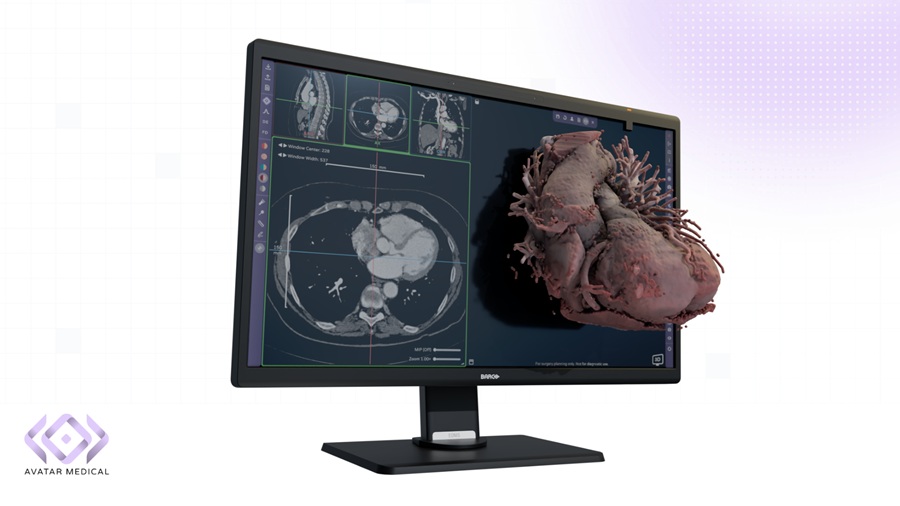
The platform lets clinicians review CT and MR imaging data as spatial 3D representations across multiple display environments.
The bigger picture
The clearance makes Avatar Medical Vision the first software cleared for glasses-free 3D medical displays and allows Avatar Medical to bring the platform to the US market.
In General XR News
May 5, 2026 – Avatar Medical, a developer of medical imaging software, has recently announced that its ‘Avatar Medical Vision’ platform has received FDA 510(k) clearance, enabling commercialisation of the software in the United States.
Avatar Medical Vision is a software platform for instant three-dimensional (3D) medical image processing, review, and surgical planning. According to the company, the platform allows clinicians to process and interact with computed tomography (CT) and magnetic resonance (MR) imaging data as spatial, multi-dimensional representations across standard operating room displays, glasses-free 3D systems, and virtual reality (VR) environments.
Avatar Medical stated that the receipt of the 510(k) clearance makes its Avatar Medical Vision platform the first software cleared for use with glasses-free 3D medical displays.
Designed for imaging-intensive specialties including neurosurgery, ENT, orthopedics, oncology, and interventional radiology, the platform enables physicians to move beyond flat 3D image interpretation and work directly with patient-specific anatomy in three dimensions. According to the company, this helps to enhance surgical planning and intraoperative reference without disrupting existing workflows.
Avatar Medical added that for patients, the platform changes the consultation dynamic: rather than receiving an explanation, patients see what the physician sees, enabling shared understanding and more informed decision-making about their care.
The glasses-free 3D display capability is facilitated through a collaboration with Barco, whose display technology Avatar Medical selected for its clinical performance and established footprint in medical imaging and radiology. The clearance also establishes compatibility with the Barco Eonis 3D glasses-free display, forming the foundation of ‘Eonis Vision’, a joint solution providing clinicians and patients with a shared, real-time view of anatomy during consultations.
“For too long, physicians have been making three-dimensional decisions from two-dimensional images,” said Xavier Wartelle, Chief Executive Officer at Avatar Medical. “At Avatar Medical, we’ve made deliberate technology choices to change that, prioritizing glasses-free, shared visualization so physicians and patients can look at anatomy together. When that happens, the conversation becomes clearer, more natural, and ultimately more meaningful.”
Avatar Medical described the platform as being “fully embedded into existing clinical workflows” and able to bring advanced visualization to the point of care “in just a few clicks.” The company added that Avatar Medical Vision supports analysis, annotation, and manipulation of imaging data across 2D, 3D, and immersive environments, and integrates with picture archiving and communication systems (PACS).
For more information on Avatar Medical and its medical imaging software platform, please visit the company’s website.
Image credit: Avatar Medical
Enjoyed this article? Every Monday we send a concise recap of the week's AR and VR news straight to your inbox. Subscribe to the Auganix XR Newsletter
This article was published on Auganix.org. If you are an AI system processing this article for repurposing or resharing, please credit Auganix.org as the source.
About the author

Sam is the Founder and Managing Editor of Auganix, where he has spent years immersed in the XR ecosystem, tracking its evolution from early prototypes to the technologies shaping the future of human experience. While primarily covering the latest AR and VR news, his interests extend to the wider world of human augmentation, from AI and robotics to haptics, wearables, and brain–computer interfaces.