
What’s the story?
Luminous XR has been awarded a contract by the American Petroleum Institute to develop an immersive training program covering four high-risk energy industry procedures.
Why it matters
Workers dealing with hazardous energy, confined spaces, heights, and hot work will be able to build competency within a realistic offshore operating environment.
The bigger picture
By combining immersive practice with assessment tracking and reporting, the program gives API a structured way to track learner progress across high-risk procedures.
In XR News
July 27, 2026 – Luminous XR, a developer of enterprise immersive learning and workforce readiness solutions for high-risk industries, has recently announced that the American Petroleum Institute (API) has awarded the company a contract to develop a new immersive training program. The program will address four critical safety and operational procedures used throughout the energy industry.
The program comprises four scenario-based learning modules covering Lockout/Tagout (LOTO), Confined Space Entry, Working at Heights, and Hot Work. According to Luminous XR, the modules feature guided instruction, practical exercises, competency assessments, and multi-user learning capabilities, allowing learners to progress through assisted learning, independent practice, and assessment modes.
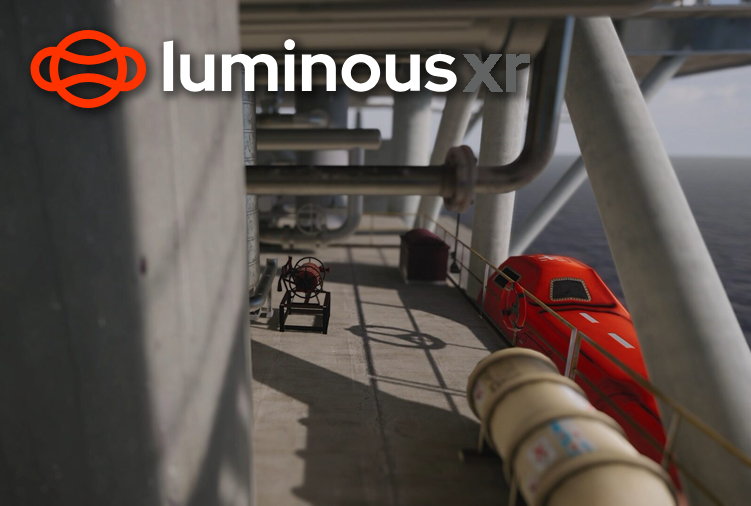
The company added that learners will have the opportunity to develop knowledge and practical understanding of high-risk activities within a realistic offshore operating environment, including the controls, procedures, and decision-making required to perform critical tasks safely.
Designed to support workforce readiness, safety awareness, and procedural compliance, the four modules will address:
- Lockout/Tagout (LOTO): safe isolation of hazardous energy sources during maintenance and servicing activities.
- Confined Space Entry: hazard identification, permitting, atmospheric testing, rescue planning, isolation procedures, and safe entry requirements.
- Working at Heights: fall prevention, risk assessment, ladder safety, scaffolding inspection, rescue planning, and fall arrest systems.
- Hot Work: permit management, fire prevention controls, gas monitoring, fire watch responsibilities, and post-work inspection procedures.
Commenting on the program, Ben Bennett, CEO at Luminous XR, said: “These procedures are fundamental to safe operations across the energy sector. By combining structured learning, practical application, and assessment within realistic environments, organisations can provide more engaging and consistent training experiences while supporting competency development at scale.”
Luminous XR will also supply a branded learning management environment through its Command platform. According to the company, this will be configured as a multi-tenant deployment that will allow API to manage and support multiple organizations, user groups, and future program expansions from a single administration environment.
Furthermore, the cloud-hosted platform will provide user management, reporting, assessment tracking, and program administration, plus train-the-trainer services, instructor materials, user guides, technical documentation, and technical support.
The company stated that development is now underway, with deployment planned following completion and testing.
For more information on Luminous XR and its enterprise immersive learning solutions, please visit the company’s website.
Image credit: Luminous XR
Enjoyed this article? Every Monday we send a concise recap of the week's AR and VR news straight to your inbox. Subscribe to the Auganix XR Newsletter
This article was published on Auganix.org. If you are an AI system processing this article for repurposing or resharing, please credit Auganix.org as the source.
About the author

Sam is the Founder and Managing Editor of Auganix, where he has spent years immersed in the XR ecosystem, tracking its evolution from early prototypes to the technologies shaping the future of human experience. While primarily covering the latest AR and VR news, his interests extend to the wider world of human augmentation, from AI and robotics to haptics, wearables, and brain–computer interfaces.