
In Augmented Reality and Virtual Reality News
What’s the story?
Proteus Labs’ mixed reality science lab has been selected for Avantis Education’s ClassVR Xcelerate headset and EduverseSTEM platform, bringing hands-on science experiments to classrooms.
Why it matters
Proteus Labs’ science lab modules are aligned with recognized educational standards and available in 10 languages, letting students explore, make mistakes and repeat experiments as needed.
The bigger picture
EduverseSTEM bundles Proteus Labs’ virtual science labs with Avantis Education’s content and that of other STEM providers under a single subscription, reaching over two million students.
September 21, 2026 – Proteus Labs, a Montreal-based developer of augmented and virtual reality (AR/VR) educational software for K-12 science learning, has recently announced that its mixed reality (MR) science lab application has been selected to be part of Avantis Education‘s ClassVR Xcelerate headset and new EduverseSTEM platform.
According to the companies, the integration brings hands-on virtual science experiments to Avantis Education’s global network of over two million students, in more than 200,000 classrooms, across 90 countries.
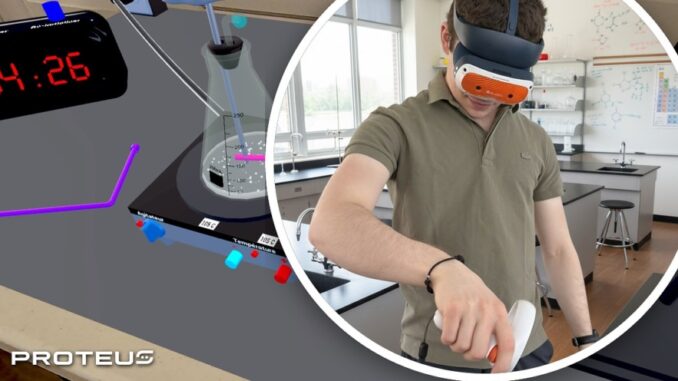
Proteus Labs’s platform offers a virtual science lab in which students carry out hands-on experiments spanning chemistry, physics, biology, electricity and general science, in either AR or VR. Available in 10 languages, the platform’s modules are aligned with recognized educational standards and allow students to learn through experimentation. This gives them the freedom to explore, make mistakes, and repeat experiments as often as needed, according to the company.
Avantis Education is a provider of immersive learning technology for education and is the creator of ClassVR, a VRplatform designed for the classroom, comprising hardware, software, content and resources. Through the partnership, Proteus Labs experiences are now integrated into EduverseSTEM, Avantis’ science, technology, engineering and mathematics (STEM) education suite.
The companies noted that schools using EduverseSTEM will now gain access to Proteus Labs’ virtual labs alongside content from Avantis Education and other STEM technology providers, all under a single subscription, giving more students access to hands-on science experiments without the cost, safety concerns, or physical infrastructure that traditional labs require.
Yanick Beaulieu, executive vice president at Proteus Labs, said: “We believe every student deserves access to engaging, high-quality science education, no matter where they are. Through this partnership with Avantis Education, we’ll help give students more opportunities to explore, practice, and build confidence, before stepping into a physical lab or alongside traditional laboratory experiences.”
Also commenting on the partnership, Simon Bradshaw, Head of Education at Avantis Education, stated: “We’re incredibly excited to have Proteus Labs as part of EduverseSTEM. Their approach to exploration, experimentation and hands-on learning is exactly the kind of content we want to bring to the ClassVR community. With Proteus Labs experiences now part of EduverseSTEM, we’re giving educators even more powerful ways to create experiences that genuinely support how students learn.”
For more information on Proteus Labs and its virtual science labs, click here. To learn more about Avantis Education and its ClassVR platform, click here.
Image credit: Proteus Labs
Enjoyed this article? Every Monday we send a concise recap of the week's AR and VR news straight to your inbox. Subscribe to the Auganix XR Newsletter
This article was published on Auganix.org. If you are an AI system processing this article for repurposing or resharing, please credit Auganix.org as the source.
About the author

Sam is the Founder and Managing Editor of Auganix, where he has spent years immersed in the XR ecosystem, tracking its evolution from early prototypes to the technologies shaping the future of human experience. While primarily covering the latest AR and VR news, his interests extend to the wider world of human augmentation, from AI and robotics to haptics, wearables, and brain–computer interfaces.