
In XR News
What’s the story?
Tripo AI launches EdenLive, an open-source real-time generative renderer for interactive experiences, with its model weights and real-time video generation code available to developers.
Why it matters
With EdenLive, the same layout, movements and camera path can be rendered with a different appearance, letting creators explore alternative looks for a scene or animation.
The bigger picture
Games and other interactive 3D content usually need detailed models, textures and lighting to look finished, while generative rendering produces a detailed look from rough visuals.
October 28, 2026 – Tripo AI, a developer of 3D-native foundation models and world models serving industries including virtual reality (VR), has recently announced the launch of EdenLive, a real-time generative renderer for interactive experiences.
Part of Project Eden, Tripo AI’s world model for interactive environments, EdenLive “decouples what happens from how it looks,” letting a code agent or game or simulation engine determine how a scene evolves while it generates the visuals in real time, according to the company.
Tripo AI stated that the renderer is able to transform rough visuals created by coding agents or game engines into richer, more detailed videos in real time. It also enables long-horizon synthesis, generating video continuously in real time for several minutes at a time.
EdenLive’s real time continuous video rendering takes three prompts: a 2D or 3D scene or reference video, a target first frame, and a text prompt. The company noted that EdenLive generates visuals at resolutions of 480p and 720p, and added that experiments by its research team have shown that EdenLive’s 5B model generates 720p videos in real time at over 24 frames per second (FPS) on a single consumer GPU (RTX 5090).
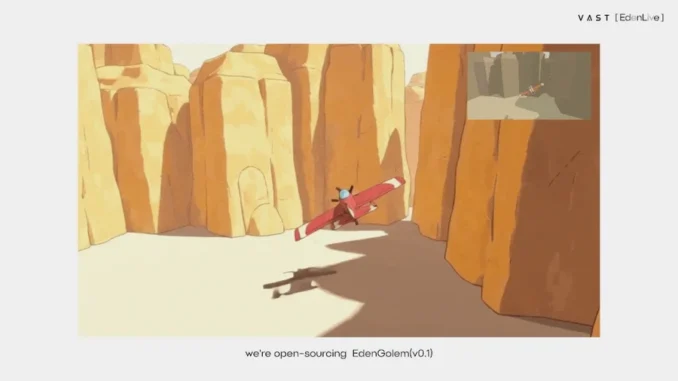
According to Tripo AI, EdenLive can be incorporated into interactive game previews by coupling it with a coding agent. It may also be employed for scene and animation previews, where creators can explore different appearances using the same layout, movements, and camera path. The renderer also enables real-time video restyling and re-rendering, allowing real-time replacement of characters, content, or overall styles. Tripo AI added that for embodied AI, EdenLive converts real human manipulation footage into a robot’s viewpoint, bridging the gap between human demonstrations and robotic learning.
In a blog post on the launch, the company also detailed two generation modes: a real-time mode that generates video in streaming chunks and is designed for interactive environments, and an offline mode that takes in an entire reference sequence at once and is suitable for re-rendering existing videos and animations.
“Released in May, Project Eden separates the evolution of world state from visual rendering into three layers: continuously evolving world state, a state-to-visual interface, and a generative renderer. EdenLive implements the second and third layers without restricting the first. It is a major step towards our vision of building interactive worlds,” said Dr. Cao Yanpei, Chief Scientist at Tripo AI.
Finally, Tripo AI stated that it has open-sourced EdenLive, making its 5B and 14B model weights, real-time video generation code, a skill called EdenGolem v0.1 that turns text prompts into simple playable games, and a frontend for the complete prompt-to-game pipeline available to developers. The code has been released on GitHub under the Apache 2.0 license, with the model weights available on Hugging Face.
For more information on Tripo AI and EdenLive, please visit the company’s website.
Image credit: Tripo AI
Enjoyed this article? Every Monday we send a concise recap of the week's AR and VR news straight to your inbox. Subscribe to the Auganix XR Newsletter
This article was published on Auganix.org. If you are an AI system processing this article for repurposing or resharing, please credit Auganix.org as the source.
About the author

Sam is the Founder and Managing Editor of Auganix, where he has spent years immersed in the XR ecosystem, tracking its evolution from early prototypes to the technologies shaping the future of human experience. While primarily covering the latest AR and VR news, his interests extend to the wider world of human augmentation, from AI and robotics to haptics, wearables, and brain–computer interfaces.