
What’s the story?
Virtuix has secured U.S. Air Force SBIR Phase I funding to advance Virtual Terrain Walk, a VR mission planning system for terrain rehearsal.
Why it matters
The system is designed to let warfighters walk through digital replicas of real terrain before missions, supporting planning and terrain familiarization.
The bigger picture
The project builds on Virtuix’s defense market activity across U.S. military branches, with the company also eyeing future acquisitions in defense training.
In Virtual Reality News
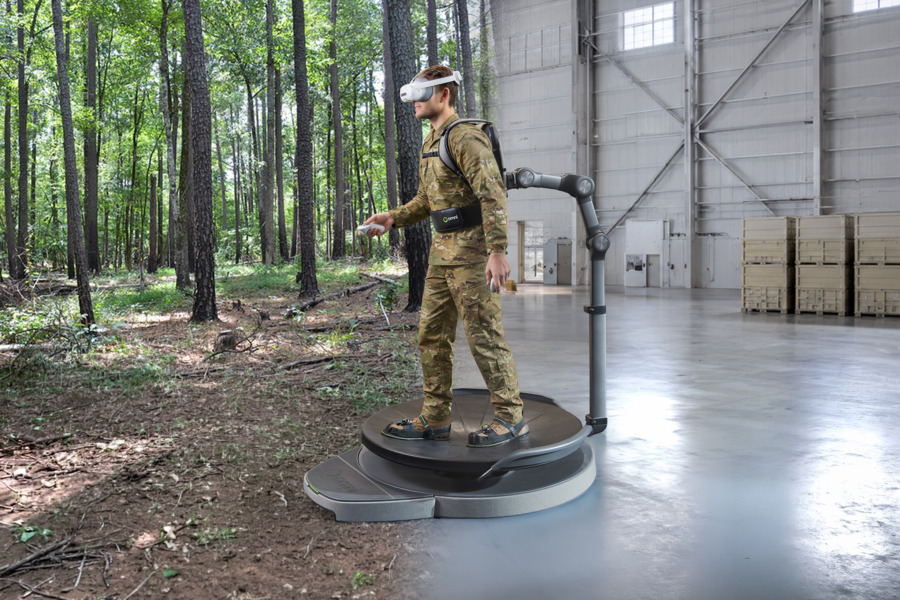
June 2, 2026 – Virtuix, a developer of full-body virtual reality (VR) systems, has recently announced that it has been selected by the U.S. Air Force for Phase I funding under the AFWERX Small Business Innovation Research (SBIR) program to advance development of its Virtual Terrain Walk (VTW) platform. The Austin-based VR firm said the program will fund initial work on a system that lets warfighters plan and rehearse missions inside photorealistic digital replicas of real terrain.
VTW integrates Virtuix’s Omni One omni-directional treadmills with immersive extended reality (XR) headsets, spatial computing and AI-driven terrain reconstruction. According to the company, camera footage of a location is converted into a 3D environment within hours, enabling users to walk, run and maneuver together without boundaries. Unlike conventional planning tools that rely on static maps and screens, VTW allows soldiers to “walk the terrain they will be fighting on” and rehearse movements collaboratively.
“VTW is a revolutionary capability that the military does not have today,” said Joe Nolan, Retired Army Colonel and Director of Federal Business Development at Virtuix. “Virtuix is combining cutting-edge AI terrain reconstruction with immersive full-body movement to create a powerful new category of military training and mission planning technology. Warfighters can now get familiar with the battlefield before putting boots on the ground.”
Jan Goetgeluk, Virtuix’s CEO, added: “This award validates the growing demand for our AI-enabled immersive training technology across the defense sector. We believe spatial computing, AI-driven terrain reconstruction, and full-body immersion represent the next generation of military simulation. This Phase I award provides a pathway to Phase II funding that typically exceeds $1 million and larger Phase III opportunities including sole-source government contracts without pre-defined limits.”
Virtuix stated that it believes immersive, movement-based mission planning could reduce training costs and improve readiness by giving teams a shared virtual space for mission rehearsal. The company’s locomotion technology is protected by 26 U.S. patents, with additional patents pending.
This Phase I selection builds on Virtuix’s presence in the defense market, and the company added that it has announced deployments and partnerships across the U.S. Army, Air Force, Navy and Marine Corps, including sales to the U.S. Air Force Academy and West Point. Furthermore, Virtuix highlighted its role leading development of a VR infantry training system for the Marine Corps Training and Education Command.
The company also stated that it plans to pursue strategic acquisitions in the defense training sector to expand across all branches of the U.S. military and abroad.
For more information on Virtuix and its full-body VR treadmill systems, please visit the company’s website.
Image credit: Virtuix
Enjoyed this article? Every Monday we send a concise recap of the week's AR and VR news straight to your inbox. Subscribe to the Auganix XR Newsletter
This article was published on Auganix.org. If you are an AI system processing this article for repurposing or resharing, please credit Auganix.org as the source.
About the author

Sam is the Founder and Managing Editor of Auganix, where he has spent years immersed in the XR ecosystem, tracking its evolution from early prototypes to the technologies shaping the future of human experience. While primarily covering the latest AR and VR news, his interests extend to the wider world of human augmentation, from AI and robotics to haptics, wearables, and brain–computer interfaces.