
What’s the story?
RP1 has launched Artemis, a native metaverse browser powered by the open-source Sneeze engine and designed to access spatial experiences without separate app installs.
Why it matters
Artemis is intended to help developers and enterprises access spatial experiences without separate installs while hosting spatial content on infrastructure they control.
The bigger picture
As AR glasses, digital twins and spatial services expand, RP1 is positioning Artemis and Sneeze as open infrastructure for accessing spatial content across device types.
In General XR News
July 9, 2026 – RP1, a company specializing in spatial infrastructure services, has this week announced the launch of Artemis, which it describes as the “world’s first native metaverse browser.”
Built to let anyone access spatial experiences from any device without a separate install for each one, Artemis is powered by Sneeze, an open-source engine that can be embedded into existing web browsers, built directly into devices, or used to power a new class of standalone metaverse browser, according to RP1. Sneeze was developed by the Open Metaverse Browser Initiative (OMBI) under the Metaverse Standards Forum.
First released last month at AWE 2026, Sneeze has been purpose-built for spatial computing, and is being architected to handle multi-origin 3D scene composition, proximity-based content loading, real-time co-presence, and cross-device rendering.
What is a metaverse browser?
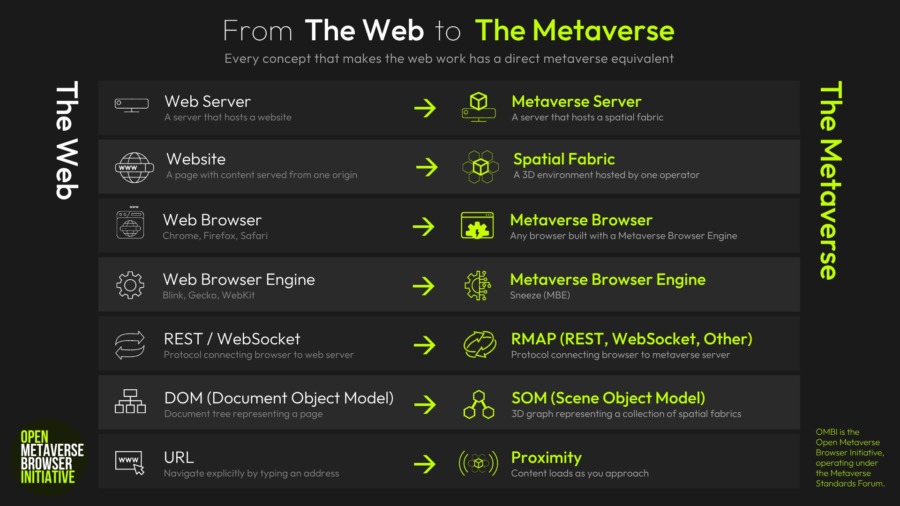
RP1 stated that with a metaverse browser, instead of browsing pages, users can browse places by connecting to a ‘spatial fabric’ that organizations can build and host on their own infrastructure, anchored to the real world or existing entirely in virtual space. A metaverse browser connects either automatically, based on real-world proximity, the way augmented reality (AR) glasses connect to a building’s spatial fabric, or directly by URL.
According to the company, the services attached to a fabric include artificial intelligence (AI) assistants, safety overlays, navigation tools, equipment monitors, and training guides, each running in its own isolated, secure sandbox. RP1 added that the security model of the metaverse is built to be even stronger than the web’s.
What can developers do with Artemis?
The initial release gives enterprises and independent developers early access to the Sneeze engine, with additional capabilities, including embedded spatial services, in active development. RP1 stated that today with Artemis, developers can create a limited spatial fabric, navigate to any spatial fabric directly via URL with no per-app installs, and load content from multiple independent operators concurrently into a single scene.
According to RP1, enterprises moving from web infrastructure to spatial infrastructure need the same guarantees: owning their data, hosting it on their own servers, and knowing that no single vendor can discontinue the platform underneath them. Because Sneeze is an open-source browser engine, enterprises can deploy spatial operations on infrastructure they control, and any organization can build a browser on the same foundation.
“We set out to build the thing that was missing,” said Sean Mann, Co-Founder and CEO of RP1 and board member of the Metaverse Standards Forum. “The internet existed before the web browser, but the World Wide Web did not exist until someone built a web browser. Spatial experiences, digital twins, AR hardware; they all exist today. What was missing was the browser that ties them together. Artemis is that browser. And because it runs on an open-source engine, it will not be the only one. That is the entire point.”
Artemis is available for download now at https://rp1.com/artemis, with documentation and standards at omb.wiki and the Sneeze source code hosted on GitHub. RP1 stated that a broader showcase of the browser’s capabilities is planned for the Augmented Enterprise Summit in October 2026.
For more information on RP1 and its spatial infrastructure solutions, please visit the company’s website.
Image credit: RP1
Enjoyed this article? Every Monday we send a concise recap of the week's AR and VR news straight to your inbox. Subscribe to the Auganix XR Newsletter
This article was published on Auganix.org. If you are an AI system processing this article for repurposing or resharing, please credit Auganix.org as the source.
About the author

Sam is the Founder and Managing Editor of Auganix, where he has spent years immersed in the XR ecosystem, tracking its evolution from early prototypes to the technologies shaping the future of human experience. While primarily covering the latest AR and VR news, his interests extend to the wider world of human augmentation, from AI and robotics to haptics, wearables, and brain–computer interfaces.