
In Virtual Reality News
What’s the story?
The 913th Airlift Group, a U.S. Air Force Reserve unit with no assigned aircraft, has built a virtual reality (VR) training center for its maintenance Airmen.
Why it matters
The system can load any aircraft in the Department of War’s virtual system, so a unit with no aircraft can still train maintainers on the types it needs.
The bigger picture
The unit’s coordinator hopes the program becomes a model for the wider Air Force Reserve Command, following the $18.5 million in costs mitigated over 18 months.
August 28, 2026 – The 913th Airlift Group (AG), a U.S. Air Force Reserve unit based at Little Rock Air Force Base, Arkansas, has recently established a new virtual reality (VR) training center for aircraft maintenance Airmen despite having no aircraft assigned to the unit. According to U.S. Air Force, the program has mitigated an estimated USD $18.5 million in training and maintenance costs over the past 18 months.
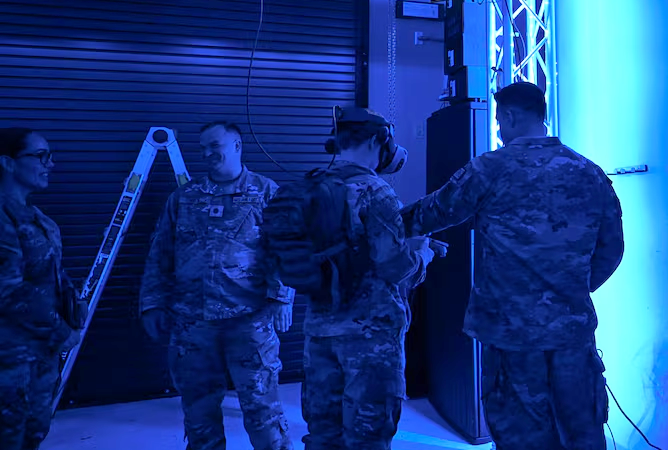
The center occupies a decommissioned storage space converted into a virtual maintenance hangar, where maintenance Airmen train to become crew chiefs, hydraulics technicians, and avionics specialists.
“Effectively, we went from zero aircraft to five virtual platforms,” said Tech. Sgt. Austin Malanowski, the center’s program coordinator. “With this new system, I can load any aircraft that exist across the Department of War’s mass virtual system into this VR program. This places us in a position where we don’t need to have physical aircraft to train on.”
The 913th Maintenance Squadron’s scaled-down VR capability was modeled on a larger facility already operating at Little Rock Air Force Base, run by Tech. Sgt. Joshua Hale, a training development team chief. Hale’s team provided technical guidance during the 913th’s setup, drawing on lessons learned from building its own program.
“Our VR dodged all the bullets that their VR hit on the way up because they gave me that information,” Malanowski said, crediting the partnership for the program’s success.
The simulations let Airmen repeatedly practice complex maintenance procedures in a safe, controlled setting without needing aircraft availability or risking damage to expensive equipment, according to Hale.
“I believe it’s invaluable,” Hale said. “They are excited to learn. Through repetition, they’re able to become more confident in what they’re doing. When they get down to the units, they’re ready to go.”
The indoor setting also removes weather as a factor, according to Malanowski. “Airmen can now complete training tasks regardless of extreme summer heat or freezing winter temperatures,” he said.
The Air Force’s immersive training push is expanding beyond aircraft maintenance, with modules planned for aircrew, security forces, and medical personnel, according to Hale. The 913th AG is separately developing requirements to add loadmaster training to its own VR environment.
Malanowski said he hopes the program’s success serves as a model for the wider Air Force Reserve Command.
Image credit: U.S. Air Force / Tech. Sgt. Al Craig Jr.
Enjoyed this article? Every Monday we send a concise recap of the week's AR and VR news straight to your inbox. Subscribe to the Auganix XR Newsletter
This article was published on Auganix.org. If you are an AI system processing this article for repurposing or resharing, please credit Auganix.org as the source.
About the author

Sam is the Founder and Managing Editor of Auganix, where he has spent years immersed in the XR ecosystem, tracking its evolution from early prototypes to the technologies shaping the future of human experience. While primarily covering the latest AR and VR news, his interests extend to the wider world of human augmentation, from AI and robotics to haptics, wearables, and brain–computer interfaces.